
Unpaid Leave in Malaysia: Rules, Salary Calculation & HR Guide
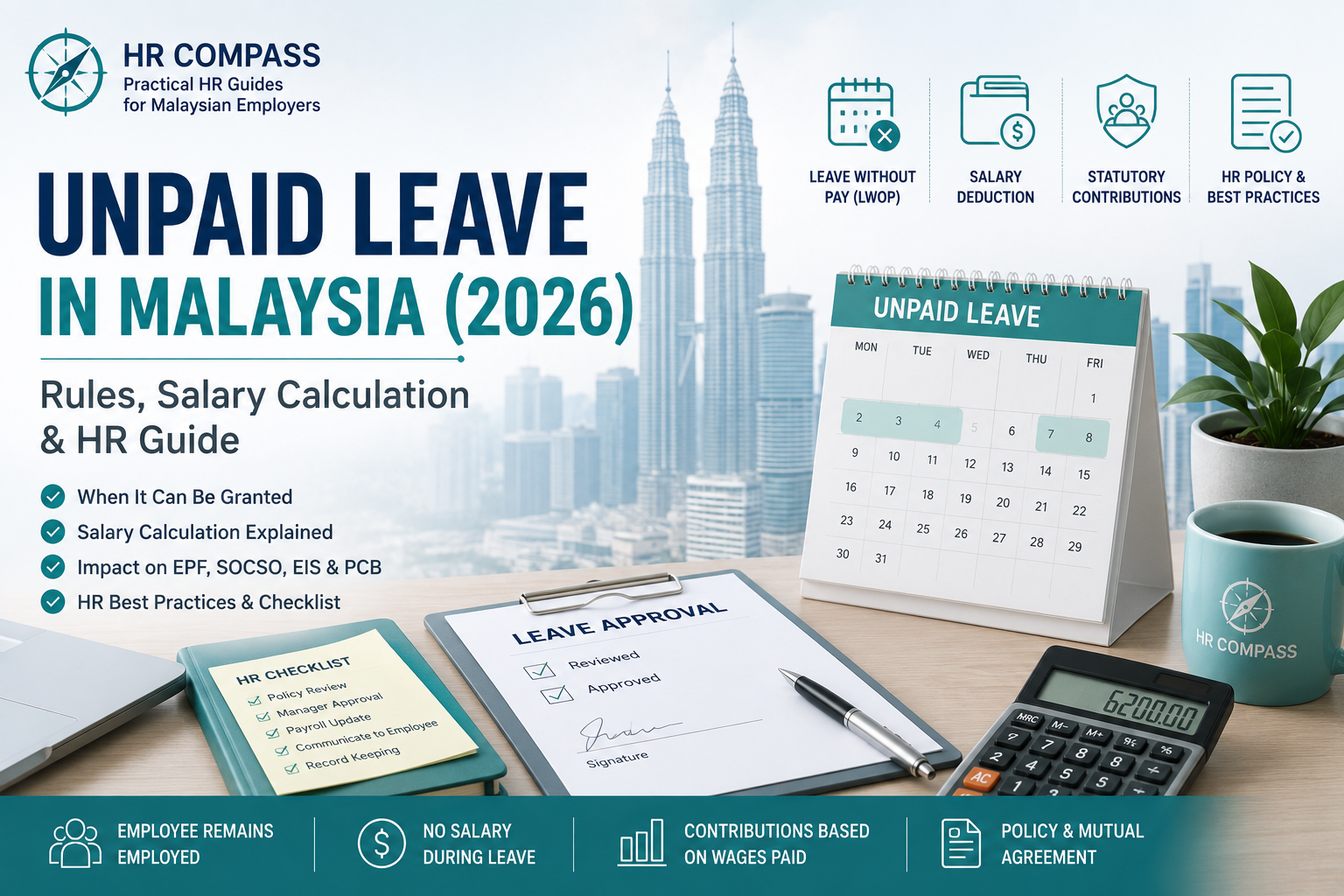
Quick Summary
Unpaid leave is one of the most common leave arrangements in Malaysian workplaces, but it is also one of the most misunderstood.
Unlike Annual Leave or Sick Leave, unpaid leave is not a statutory entitlement under the Employment Act 1955. Whether an employee may take unpaid leave depends on the employment contract, company policy, or mutual agreement between the employer and employee.
This guide explains:
- When unpaid leave can be granted
- Whether employers can reject or impose unpaid leave
- How unpaid leave affects salary
- How to calculate unpaid leave deductions
- The impact on EPF, PERKESO, EIS and PCB
- HR best practices
Malaysia Employee Leave Guide Series
Whether you're an HR professional, employer or employee, these guides cover both the minimum statutory leave entitlements under the Employment Act 1955 and the additional company leave benefits commonly offered in Malaysia.
- Part 1: Malaysia Employee Leave Guide (2026): Statutory Leave Entitlements
- Part 2: Malaysia Employee Leave Guide (2026): Non-Statutory Company Leave
What Is Unpaid Leave?
Unpaid leave (also known as Leave Without Pay (LWOP) or No-Pay Leave) is a period during which an employee is approved to be absent from work without receiving salary for the approved leave period.
Unlike statutory leave, unpaid leave is not required by the Employment Act 1955. It is granted based on:
- Employment Contract
- Company Policy
- Collective Agreement
- Mutual Agreement between employer and employee
Is Unpaid Leave a Legal Entitlement?
No.
The Employment Act 1955 does not require employers to provide unpaid leave.
This means:
✅ Employers may approve unpaid leave.
✅ Employers may reject unpaid leave requests.
The approval process depends on the employer's policies and operational requirements.
Can Employers Force Employees to Take Unpaid Leave?
Generally, no.
Employers should not unilaterally place employees on unpaid leave unless:
- it is permitted under the employment contract;
- it is agreed by the employee; or
- there is another lawful basis.
Unilateral unpaid leave may expose employers to employment disputes or constructive dismissal claims.
Common Reasons Employees Request Unpaid Leave
Employees may request unpaid leave for many reasons, including:
- Family emergencies
- Medical recovery after paid sick leave has been exhausted
- Caring for parents or family members
- Childcare responsibilities
- Religious pilgrimage
- Personal travel
- Further studies
- Professional examinations
- Mental health or wellness break
- Extended overseas travel
- Personal matters
How Is Unpaid Leave Calculated?
For monthly-rated employees, salary deductions for unpaid leave are commonly calculated using the Employment Act's incomplete month salary formula.
Formula
Monthly Salary ÷ Number of Days in the Wage Period × Number of Unpaid Leave Days
Example 1 – 2 Days of Unpaid Leave
Encik Lim
Monthly Salary
RM6,200
July
31 days
Approved unpaid leave
2 days
Daily Rate
RM6,200 ÷ 31
= RM200.00
Salary Deduction
RM200 × 2
= RM400.00
Salary Payable
RM6,200 − RM400
= RM5,800.00
Example 2 – 15 Days of Unpaid Leave
Monthly Salary
RM6,200
July
31 days
Unpaid Leave
15 days
Salary Deduction
RM6,200 ÷ 31 × 15
= RM3,000.00
Salary Payable
RM6,200 − RM3,000
= RM3,200.00
Example 3 – One Full Month of Unpaid Leave
Encik Jason
Monthly Salary
RM6,000
Approved unpaid leave
1 July – 31 July
Days Worked
0
Salary Calculation
RM6,000 ÷ 31 × 0
= RM0
Salary Payable
RM0
The employee remains employed but receives no salary for that wage period.
What Happens During Unpaid Leave?
Although salary is not paid, the employment relationship generally continues.
| Item | Impact During Unpaid Leave |
|---|---|
| Employment Status | ✅ Continues |
| Salary | ❌ Reduced or Nil |
| EPF Contribution | Usually reduced or nil, depending on wages paid |
| PERKESO Contribution | Based on contributable wages |
| EIS Contribution | Based on contributable wages |
| PCB (Income Tax) | Usually reduced if taxable income decreases |
| Annual Leave Accrual | Depends on the Employment Act and company policy |
| Bonus / Incentive | May be affected if based on paid service |
Does Unpaid Leave Affect Annual Leave?
This depends on:
- the Employment Act;
- the employment contract; and
- the employer's leave policy.
Some employers continue to calculate annual leave based on continuous employment, while others may adjust pro-rated entitlements for extended periods of unpaid leave, provided the practice complies with the law and contractual terms.
HR should clearly state the company's approach in its leave policy.
Does Unpaid Leave Affect EPF, PERKESO & EIS?
Yes.
Because statutory contributions are generally calculated based on actual wages paid, unpaid leave may reduce or eliminate contributions for that payroll period.
If no wages are payable for the month, contribution obligations may also be affected.
Payroll should always verify contribution requirements before processing the monthly payroll.
HR Best Practices Before Approving Unpaid Leave
Before approving unpaid leave, HR should:
☑ Review the employment contract.
☑ Check the company's unpaid leave policy.
☑ Confirm the employee understands the salary impact.
☑ Explain the impact on statutory contributions.
☑ Explain any impact on annual leave or bonus (if applicable).
☑ Obtain written approval from the relevant manager.
☑ Keep approval records for payroll and audit purposes.
Frequently Asked Questions
Is unpaid leave required under the Employment Act?
No.
Unpaid leave is not a statutory entitlement.
Can an employer reject unpaid leave?
Yes.
Employers may approve or reject unpaid leave based on company policy and operational requirements.
Can an employer force unpaid leave?
Generally, no.
Employers should not impose unpaid leave without contractual authority, employee agreement or another lawful basis.
Is there a maximum number of unpaid leave days?
No.
The Employment Act 1955 does not prescribe a maximum duration.
The employer determines the duration based on company policy and mutual agreement.
Does unpaid leave affect EPF?
Yes.
EPF contributions are based on actual wages paid.
Where salary is reduced due to unpaid leave, EPF contributions are generally reduced accordingly.
Can employees work during unpaid leave?
Unless specifically agreed otherwise, unpaid leave means the employee is not required to work during the approved leave period. If work is performed, the arrangement should be reviewed to ensure compliance with employment and wage obligations.
HR Checklist
Before Approving Unpaid Leave
☑ Review company policy
☑ Check employee eligibility
☑ Obtain written approval
☑ Inform payroll
☑ Explain salary deduction
☑ Explain statutory contribution impact
☑ Keep approval records
Key Takeaway
Unpaid leave is not a statutory leave entitlement under the Employment Act 1955. It is granted based on company policy or mutual agreement between the employer and employee.
When processing unpaid leave, HR should ensure the arrangement is properly approved, calculate salary deductions using the appropriate wage calculation method, and communicate any impact on statutory contributions and employee benefits. A clear unpaid leave policy helps employers maintain compliance while ensuring employees understand the financial implications before taking leave.