
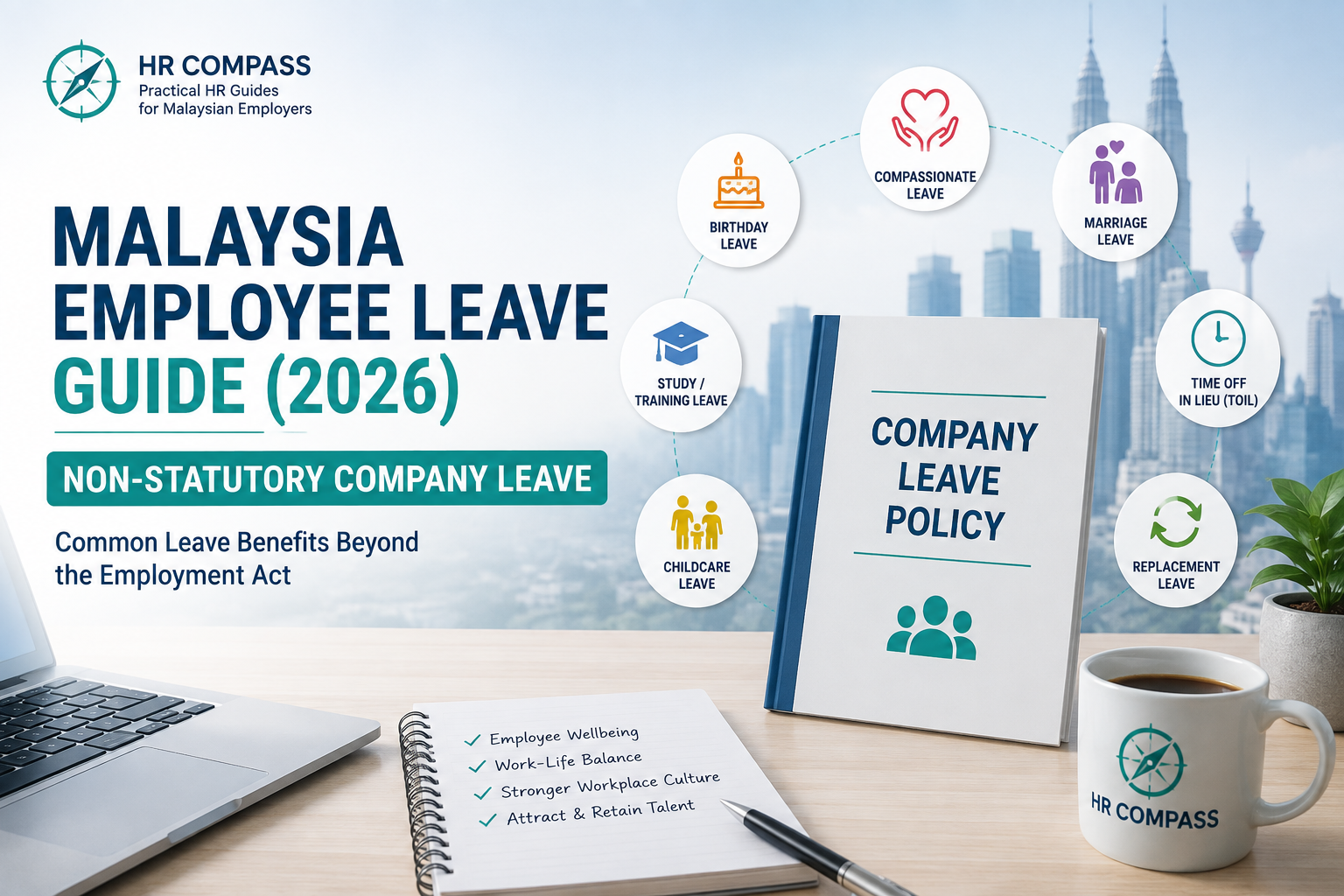
Malaysia Employee Leave Guide (2026): Non-Statutory Company Leave
Malaysia Employee Leave Guide Series
Whether you're an HR professional, employer or employee, these guides cover both the minimum statutory leave entitlements under the Employment Act 1955 and the additional company leave benefits commonly offered in Malaysia.
- Part 1: Malaysia Employee Leave Guide (2026): Statutory Leave Entitlements
- Part 2: Malaysia Employee Leave Guide (2026): Non-Statutory Company Leave
You're currently reading: Part 2 – Non-Statutory Company Leave
Quick Summary
Besides the statutory leave required under the Employment Act 1955, many employers offer additional leave benefits to improve employee wellbeing, retention and work-life balance.
At a Glance
| Leave Type | Required by Law | Common? |
|---|---|---|
| Compassionate Leave | ❌ | ⭐⭐⭐⭐⭐ |
| Marriage Leave | ❌ | ⭐⭐⭐⭐ |
| Replacement Leave | ❌* | ⭐⭐⭐⭐⭐ |
| Time Off In Lieu (TOIL) | ❌ | ⭐⭐⭐⭐⭐ |
| Emergency Leave | ❌ | ⭐⭐⭐⭐⭐ |
| Birthday Leave | ❌ | ⭐⭐⭐ |
| Study Leave | ❌ | ⭐⭐⭐ |
| Examination Leave | ❌ | ⭐⭐⭐ |
| Training Leave | ❌ | ⭐⭐⭐⭐ |
| Volunteer Leave | ❌ | ⭐⭐ |
| Childcare Leave | ❌ | ⭐⭐⭐ |
| Hajj / Umrah Leave | ❌ | ⭐⭐⭐ |
| Sabbatical Leave | ❌ | ⭐ |
| Wellness / Mental Health Leave | ❌ | ⭐⭐ |
| Jury Duty Leave | N/A (Not applicable in Malaysia) | ❌ |
1. Compassionate Leave
Usually granted when an immediate family member passes away.
Common practice:
- Parent
- Spouse
- Child
- Grandparent
Typical entitlement:
2–5 days
2. Marriage Leave
Given when an employee gets married.
Usually:
1–3 days
Often limited to the employee's first legal marriage.
3. Emergency Leave
This is probably the most misunderstood leave.
There is no Emergency Leave under the Employment Act.
When employees say
"I want emergency leave"
HR normally converts it into
- Annual Leave
- Unpaid Leave
- Compassionate Leave
- Replacement Leave
depending on company policy.
4. Replacement Leave
This deserves its own section.
Many companies use it.
Example:
Employee works on
- Sunday
- Rest Day
- Company Event
- Weekend Exhibition
Instead of paying extra,
company gives
Replacement Leave
Example
Work Sunday
↓
Take Monday off
Important:
Replacement Leave cannot automatically replace statutory overtime or public holiday payment where the Employment Act requires premium pay.
5. Time Off In Lieu (TOIL)
Many HR confuse TOIL and Replacement Leave.
Actually they're different.
Replacement Leave
↓
Usually replaces an extra working day.
TOIL
↓
Given for working additional hours.
Example
Employee worked
10pm–2am
Instead of OT claim
Company gives
4 hours TOIL.
6. Training Leave
Very common nowadays.
Example
Employee attends
- HRD Corp course
- NTW course
- Microsoft certification
- AWS certification
Normally
Training Leave
or simply considered
Working Day.
7. Study Leave
For employees pursuing:
- Degree
- Master
- ACCA
- CIMA
- CPA
- CIPD
Usually
3–10 days
before exams.
8. Examination Leave
Different from Study Leave.
Study Leave
↓
Revision
Examination Leave
↓
Actual exam day.
9. Birthday Leave
Increasingly common among startups.
Usually
1 paid day
during birthday month.
10. Childcare Leave
Some companies provide:
- Child sick leave
- Child vaccination leave
- Parent care leave
These are not statutory.
11. Hajj / Umrah Leave
Common among Malaysian employers.
Usually:
- Once during employment
- 5–14 days
- Subject to company policy
12. Volunteer Leave
Growing ESG trend.
Employees receive
1–3 paid days
for volunteer activities.
13. Wellness Leave
Very popular after COVID.
Examples:
- Mental Health Day
- Recharge Leave
- Self-care Leave
14. Sabbatical Leave
Mostly for:
- Universities
- MNCs
- Senior Management
Typically after
5–10 years
of service.
HR Checklist
Before introducing any company leave:
☑ Define eligibility.
☑ State whether paid or unpaid.
☑ Explain approval process.
☑ Include required documents.
☑ State whether unused leave expires.
☑ Configure HRMS correctly.
FAQ
Is Compassionate Leave mandatory?
No.
Is Emergency Leave required by law?
No.
Is Replacement Leave compulsory?
No.
It depends on company policy unless it is being used to satisfy statutory obligations, where employers must still comply with the Employment Act's minimum pay requirements.
Can employers offer more leave?
Yes.
The Employment Act only provides minimum statutory leave.
Employers may always provide additional leave benefits.
Key Takeaway
The Employment Act 1955 sets the minimum statutory leave entitlements, but many organisations go beyond these requirements by introducing additional company leave benefits. Well-designed leave policies can improve employee wellbeing, strengthen retention and enhance the employer brand, provided the terms are clearly documented and applied consistently.