
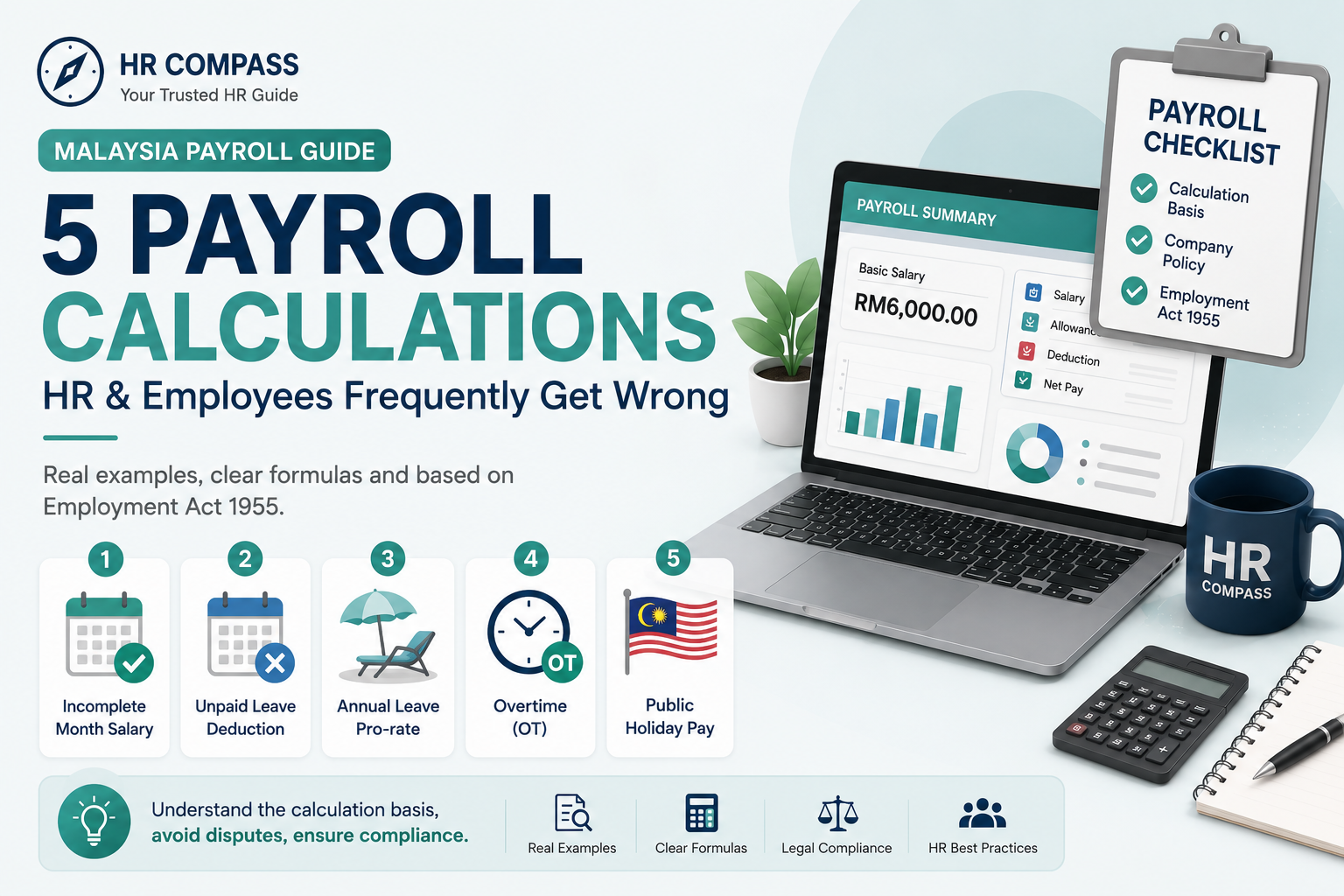
5 Payroll Calculations HR & Employees Frequently Get Wrong
Payroll disputes don't always happen because payroll is wrong.
In many cases, the confusion comes from different calculation methods, statutory requirements, employment contracts, and company policies.
This guide explains five payroll calculations that HR professionals and employees commonly misunderstand in Malaysia.
Quick Summary
| Topic | Why It Matters |
|---|---|
| Incomplete Month Salary | Employees covered under the Employment Act generally follow the statutory incomplete month wage formula. Different arrangements may apply depending on employment terms and applicable laws. |
| Unpaid Leave Deduction | Unpaid leave calculations should follow the applicable legal or contractual calculation method. |
| Annual Leave Pro-rate | Pro-rated leave entitlement depends on company policy or employment contract, provided statutory minimums are met. |
| Overtime (OT) | OT calculations depend on ordinary rate of pay, working schedule and Employment Act requirements. |
| Public Holiday Pay | Additional payment depends on whether the employee works on the public holiday and applicable statutory provisions. |
1. Incomplete Month Salary
Scenario
Encik Ali joined ABC Sdn. Bhd. on 15 May 2026.
His monthly basic salary is RM6,000.
May has 31 calendar days.
Since he worked from 15 May to 31 May, he worked 17 calendar days.
For employees covered under the Employment Act, incomplete month wages are generally calculated using the statutory formula.
Calculation
RM6,000 ÷ 31 × 17
= RM3,290.32
HR Tip: Employees often expect salary to be divided by 30 days. However, the applicable calculation should follow the statutory formula or the relevant employment terms where applicable.
2. Unpaid Leave
Scenario
Puan Siti receives a monthly basic salary of RM4,500.
She took 2 days of unpaid leave in May, which has 31 calendar days.
Example Calculation
RM4,500 ÷ 31 × 2
= RM290.32
Her unpaid leave deduction would be RM290.32 (subject to the applicable calculation method).
HR Tip: Always verify the calculation basis used by your payroll policy before concluding that payroll is incorrect.
3. Annual Leave Pro-rate
Scenario
Encik Jason joined the company on 1 July 2026.
The company provides 12 days of annual leave per year.
One common method used by employers is to pro-rate annual leave based on the actual number of calendar days worked during the year.
Example Calculation
Days employed from 1 July to 31 December:
- July: 31 days
- August: 31 days
- September: 30 days
- October: 31 days
- November: 30 days
- December: 31 days
Total Days Worked = 184 days
Annual Leave Calculation:
(184 ÷ 365) × 12
= 6.05 days
Depending on the company's leave policy, this may be:
- Rounded down to 6 days
- Rounded up according to company policy
- Credited with decimal leave entitlement if supported by the HR system
HR Tip: There is no single mandatory pro-rating formula under the Employment Act 1955. Employers may use different methods, such as:Completed months of service (e.g. 12 ÷ 12 × completed months)Actual calendar days worked (e.g. 184 ÷ 365 × annual entitlement)Other methods stated in the employment contract or company leave policy.
4. Overtime (OT)
Scenario
Puan Nurul earns RM3,000 per month.
She works a 5-day work week with 8 working hours per day.
On Monday, she worked 2 hours overtime after her normal working hours.
Example
Hourly Rate
RM3,000 ÷ 26 ÷ 8
= RM14.42
OT Pay
RM14.42 × 1.5 × 2
= RM43.26
HR Tip: The Employment Act prescribes minimum overtime entitlements. Actual calculations depend on the employee's work schedule and payroll setup.
5. Public Holiday Pay
Scenario
Encik Lim earns a monthly basic salary of RM3,000.
He was required to work on a gazetted public holiday according to his work roster.
Step 1: Calculate Daily Rate
RM3,000 ÷ 26
= RM115.38
Step 2: Calculate Public Holiday Pay
Under the Employment Act 1955, an employee who works on a public holiday is generally entitled to:
- Normal public holiday pay (already payable), plus
- 2 days' wages at the ordinary rate of pay for work performed during normal working hours.
Example:
Additional Public Holiday Pay
RM115.38 × 2
= RM230.76
Total Pay for That Public Holiday
| Description | Amount |
|---|---|
| Public Holiday Pay (already entitled) | RM115.38 |
| Additional 2 Days' Wages | RM230.76 |
| Total | RM346.14 |
HR Tip: If Encik Lim works beyond his normal working hours on the same public holiday, overtime payment must also be calculated in accordance with the Employment Act. The final amount will depend on the number of overtime hours worked.
HR Tip: Public holiday calculations depend on the employee's work arrangement, hours worked, and the applicable Employment Act provisions.