
Intern vs Apprentice in Malaysia: What's the Difference?
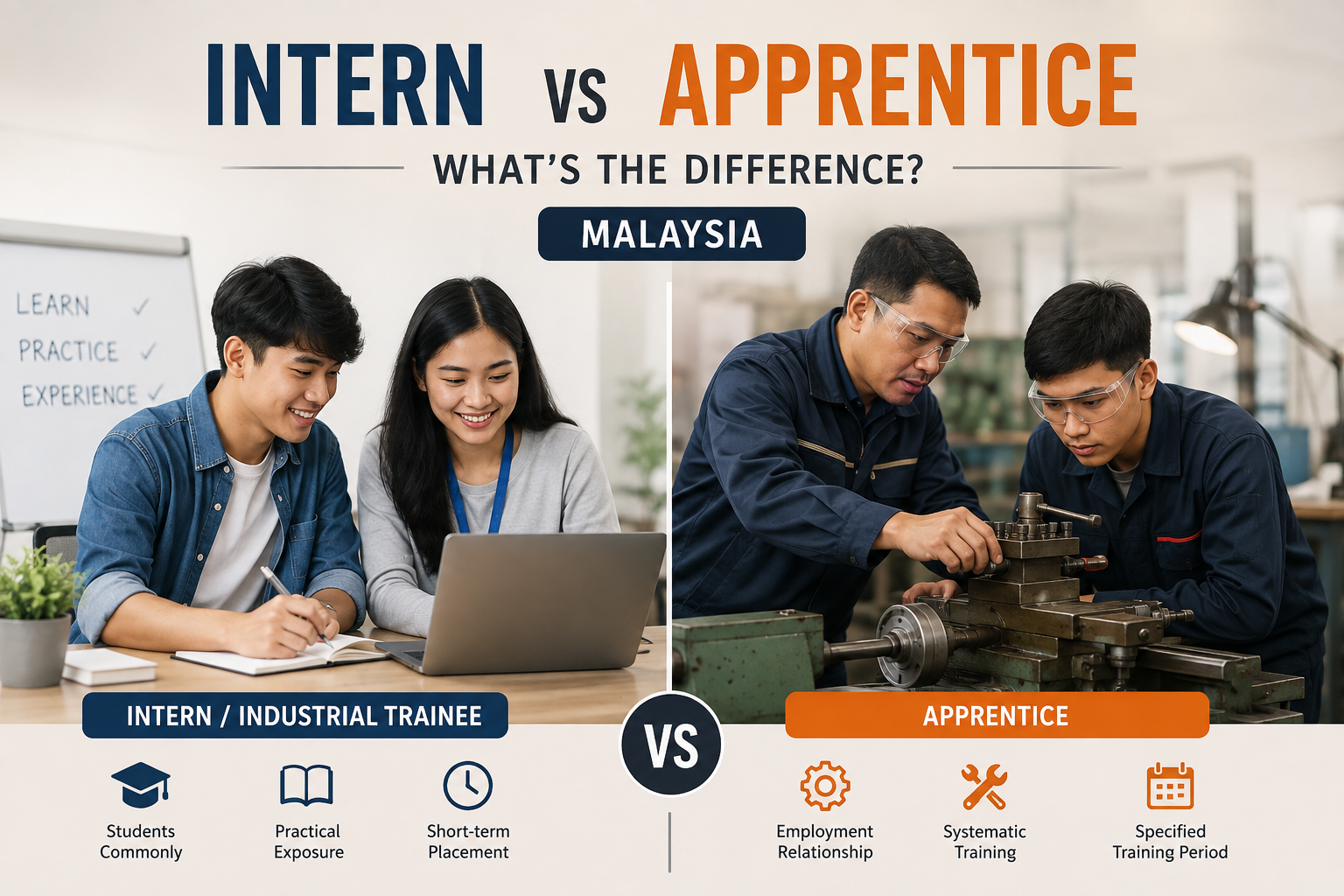
Employment Classification Guide Series
Understanding a person's employment status is important because it can affect statutory contributions, employment rights and employer responsibilities.
- Part 1: Contract of Service vs Contract for Service in Malaysia
- Part 2: Intern vs Apprentice in Malaysia: What's the Difference?
- Part 3: Malaysia Internship Guide (2026): Allowance, EPF, SOCSO, EIS & Employment Rights
- Part 4: Malaysia Apprentice Guide (2026): EPF, SOCSO, EIS & Employment Rights
You're currently reading: Part 2: Intern vs Apprentice in Malaysia: What's the Difference?
Intern vs Apprentice at a Glance
Intern and apprentice are sometimes used interchangeably, but they are not necessarily the same arrangement.
| Area | Intern / Industrial Trainee | Apprentice |
|---|---|---|
| Main purpose | Practical workplace exposure and learning | Employment + systematic training for an occupation |
| Usually who? | Commonly students completing practical / industrial training | A person employed and trained for a specific occupation |
| Must be a student? | Commonly, but the title “intern” itself does not determine legal status | No |
| University / college involvement | Common, especially for compulsory industrial training | Not required |
| Employment relationship | Depends on the actual arrangement | Apprenticeship expressly involves the employer undertaking to employ and train the person |
| Type of training | Practical workplace experience | Systematic occupational training |
| Written agreement | Depends on the internship / institution arrangement | Written Contract of Apprenticeship |
| Training period | Based on internship / academic programme | Specified period under the apprenticeship arrangement |
| EPF | Depends on whether the arrangement creates a statutory employment relationship | Contract of Apprenticeship is expressly recognised under EPF |
| SOCSO | Depends on the actual arrangement and statutory coverage | Contract of Apprenticeship is expressly recognised under PERKESO employee coverage |
| EIS | Depends on employment status and EIS eligibility | Apprenticeship is expressly included, subject to EIS eligibility |
| Minimum wage | Must check the actual arrangement and applicable minimum-wage rules | Must check applicable minimum-wage rules |
| Employment Act rights | Depends on whether an employment relationship exists and the applicable provisions | Apprenticeship is specifically recognised within the employment framework |
The easiest way to remember it
Intern = usually practical workplace exposure
Apprentice = employment + systematic occupational training
A Contract of Apprenticeship has a specific statutory meaning. It is a written contract under which an employer undertakes to employ and systematically train a person for an occupation for a specified period, while the apprentice agrees to work in the employer's service during that period.
By comparison, simply calling someone an “intern” does not by itself determine whether that person is legally an employee.
Two Simple Examples
| University Intern | Apprentice | |
|---|---|---|
| Situation | Student completes 4-month industrial training required by university | Company employs a person under a structured occupational training programme |
| Documentation | University internship / industrial-training documents | Written apprenticeship contract |
| Purpose | Gain practical workplace exposure | Become systematically trained for an occupation |
| Employment status | Must examine the actual arrangement | Apprenticeship expressly involves employment and training |
So HR should not automatically classify every person who is learning at work as an intern.
Why Does the Difference Matter?
Because the classification can affect:
| HR Area | Why It Matters |
|---|---|
| EPF | Statutory contribution requirements differ depending on the legal relationship |
| SOCSO | Employee coverage depends on the applicable statutory definition |
| EIS | Employment status and statutory eligibility matter |
| Minimum wage | Whether minimum-wage requirements apply needs to be determined from the actual arrangement |
| Employment Act | Leave, working hours and other rights depend on the applicable employment relationship |
| HR documentation | Internship documentation and apprenticeship contracts are not necessarily interchangeable |
The important rule for HR is:
Don't decide statutory treatment from the title “Intern” or “Apprentice” alone. Check the actual arrangement.
HR Checklist: Intern or Apprentice?
| Check | More Likely Intern | More Likely Apprentice |
|---|---|---|
| Currently undertaking university / college industrial training | ✓ | |
| Placement required by education institution | ✓ | |
| University internship letter / evaluation required | ✓ | |
| Main purpose is practical workplace exposure | ✓ | |
| Written Contract of Apprenticeship | ✓ | |
| Employer undertakes to employ and systematically train the person | ✓ | |
| Training is for a specific occupation | ✓ | |
| Apprentice works in employer's service during training | ✓ | |
| Apprenticeship has a specified period | ✓ |
Note: This is a practical HR comparison, not a standalone legal classification test. The actual agreement and working relationship still need to be considered.
Frequently Asked Questions
Are intern and apprentice the same?
No. Both may involve workplace learning, but a Contract of Apprenticeship has a specific statutory concept involving employment + systematic occupational training under a written contract.
Must an intern be a student?
Not necessarily based on the title alone, although internships and industrial training are commonly associated with students.
Must an apprentice be a student?
No. The apprenticeship concept focuses on employment and systematic training for an occupation.
Does an intern need EPF, SOCSO and EIS?
It depends on the actual arrangement and whether the relevant statutory requirements are met. We will break this down separately in Part 3.
Does an apprentice need EPF, SOCSO and EIS?
A Contract of Apprenticeship is expressly recognised under the EPF and PERKESO statutory frameworks. The exact contribution requirements and eligibility will be covered in Part 4.
Key Takeaway
An intern usually joins a company for practical workplace exposure, while an apprentice is employed under a structured arrangement to receive systematic training for an occupation. The title alone should not determine the person's statutory treatment. HR should always check the actual arrangement and employment relationship before deciding which statutory obligations apply.