
Malaysia Apprentice Guide (2026): EPF, SOCSO, EIS & Employment Rights
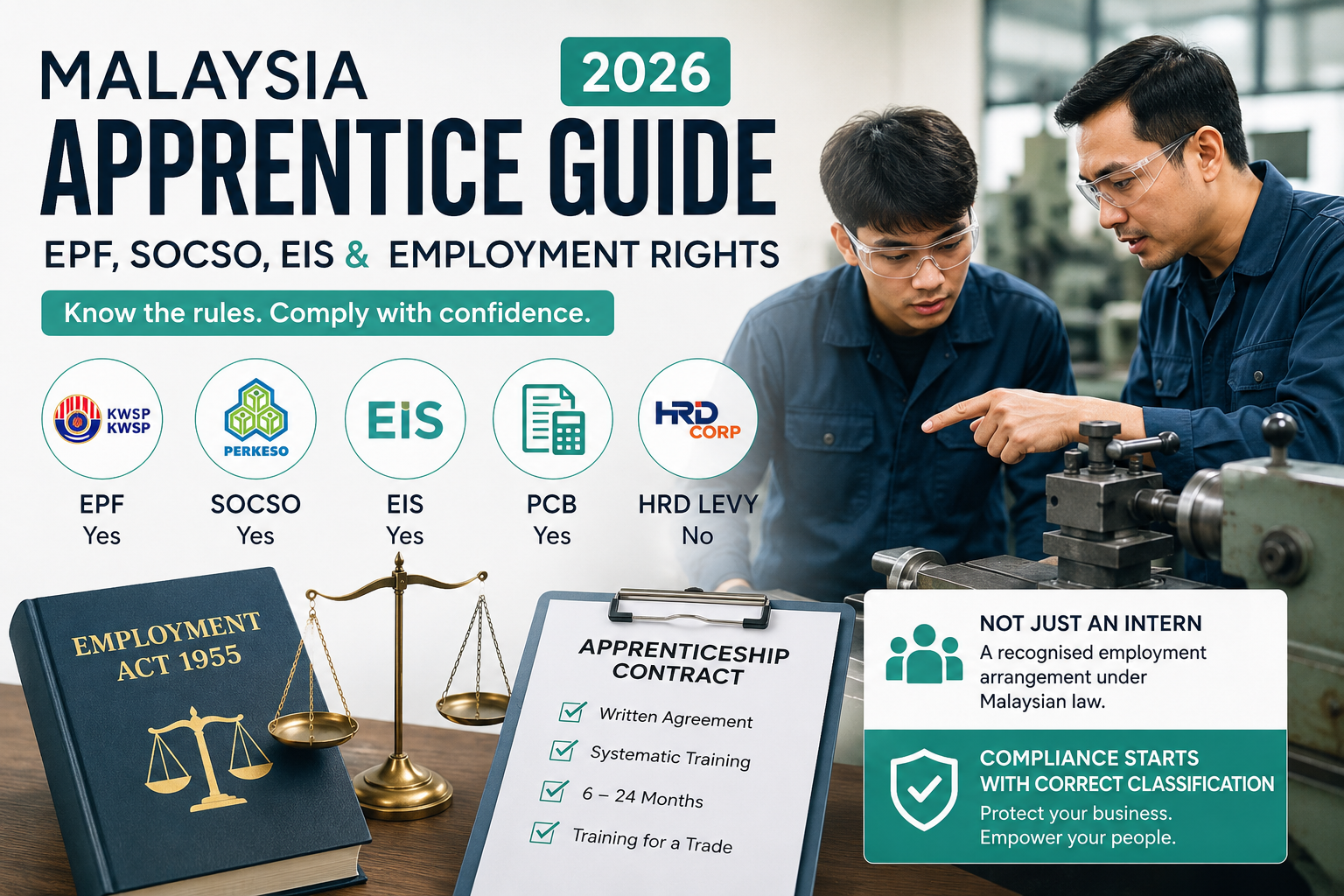
Employment Classification Guide Series
Understanding a person's employment status is important because it can affect statutory contributions, employment rights and employer responsibilities.
Part 1: Contract of Service vs Contract for Service in Malaysia
Part 2: Intern vs Apprentice in Malaysia: What's the Difference?
Part 3: Malaysia Internship Guide (2026): Allowance, EPF, SOCSO, EIS & Employment Rights
Part 4: Malaysia Apprentice Guide (2026): EPF, SOCSO, EIS & Employment Rights
You're currently reading: Part 4: Malaysia Apprentice Guide (2026): EPF, SOCSO, EIS & Employment Rights
At a Glance
| Item | Apprentice Position |
|---|---|
| Formal legal status | Recognised under the Employment Act 1955 |
| Written contract required? | Yes |
| Apprenticeship period | Minimum 6 months, maximum 24 months |
| EPF | Yes |
| SOCSO | Yes, subject to eligibility |
| EIS | Yes, subject to eligibility |
| PCB | Yes, include remuneration in PCB calculation |
| HRD Levy on apprentice allowance | No |
| Minimum Wage RM1,700 | Not mandatory for a valid Contract of Apprenticeship |
What Is an Apprentice?
Under the Employment Act 1955, a Contract of Apprenticeship is a written contract where an employer undertakes to employ and systematically train a person for a trade for a specified period.
The apprenticeship period must be at least 6 months and no more than 24 months, during which the apprentice is bound to work in the employer's service.
This is an important distinction because an apprentice is not simply another name for an intern or trainee.
Apprentice vs Intern
| Area | Intern / Industrial Trainee | Apprentice |
|---|---|---|
| Main purpose | Practical workplace exposure | Employment + systematic training for a trade |
| Usually a student? | Commonly | Not necessarily |
| Written apprenticeship contract | No | Yes |
| Statutory apprenticeship period | No | 6–24 months |
| Employment relationship | Depends on actual arrangement | Built into the apprenticeship arrangement |
| Statutory contributions | Depends on legal relationship | Apprenticeship is expressly recognised by the relevant statutory frameworks |
| RM1,700 minimum wage | Depends on employment status | Not mandatory for a valid Contract of Apprenticeship |
Statutory Contributions & Payroll Treatment
A major difference between a genuine student internship and an apprenticeship is that Malaysian statutory frameworks expressly recognise persons working under a Contract of Apprenticeship.
For payroll purposes, the treatment can be summarised as follows:
| Apprentice Allowance | Treatment |
|---|---|
| EPF | Yes |
| SOCSO | Yes, subject to eligibility |
| EIS | Yes, subject to eligibility |
| PCB | Yes — include in PCB calculation |
| HRD Levy | No |
EPF
KWSP expressly includes persons employed under a Contract of Service or Apprenticeship within its contribution framework. KWSP also identifies allowances among payments liable for EPF contribution.
Therefore, an apprentice should not be excluded from EPF merely because the payment is called an “apprentice allowance.”
SOCSO & EIS
PERKESO's statutory coverage includes eligible employees working under a Contract of Service or Apprenticeship. The applicable SOCSO and EIS requirements should therefore be applied according to the apprentice's statutory eligibility rather than treating apprenticeship itself as an exemption.
PCB
Apprentice remuneration should be included in the PCB calculation.
This does not mean that every apprentice will actually have tax deducted. The final PCB amount may still be RM0, depending on the employee's remuneration and the official PCB calculation.
HRD Levy
HRD Corp specifically excludes allowances paid under an apprentice contract from wages used for levy calculation.
Therefore:
Apprentice Allowance → HRD Levy: No
Does the RM1,700 Minimum Wage Apply?
No, not to a valid Contract of Apprenticeship.
Malaysia's Minimum Wages Order 2024 establishes the RM1,700 minimum wage for covered employees, but official labour-department guidance excludes employees under an apprenticeship contract from the Minimum Wages Order.
Therefore, an employer is not required to pay an apprentice at least RM1,700 per month merely because RM1,700 is Malaysia's current minimum wage.
However, calling someone an “apprentice” does not automatically create this exemption. The arrangement should genuinely meet the Employment Act definition, including a written apprenticeship contract, systematic training for a trade and a 6–24 month apprenticeship period.
What Employment Rights Does an Apprentice Have?
An apprenticeship is a legally recognised employment arrangement under the Employment Act 1955.
However, HR should not assume that every provision applying to an ordinary employee necessarily operates identically for an apprentice. The relevant Employment Act provision should be checked for the particular entitlement or issue involved.
The important starting point is:
An apprentice is not simply an intern receiving training — apprenticeship has its own statutory recognition.
Practical Example
A manufacturing company engages Adam under a 12-month written apprenticeship contract.
The company will employ Adam while systematically training him in a technical trade, and Adam receives a monthly apprentice allowance.
Because the arrangement satisfies the core characteristics of an apprenticeship, HR should configure the apprentice allowance accordingly:
| Item | Payroll Treatment |
|---|---|
| EPF | Yes |
| SOCSO | Yes, subject to eligibility |
| EIS | Yes, subject to eligibility |
| PCB | Yes |
| HRD Levy | No |
| RM1,700 Minimum Wage | Not mandatory |
Notice that the fact Adam receives an “allowance” rather than a “salary” does not by itself determine his statutory treatment. His legal relationship with the company is the important starting point.
HR Checklist
Before engaging an apprentice, HR should confirm:
- A written Contract of Apprenticeship is in place.
- The apprentice will receive systematic training for a trade.
- The apprenticeship lasts between 6 and 24 months.
- The correct EPF, SOCSO, EIS and PCB treatment is configured.
- Apprentice-contract allowance is excluded from HRD levy calculation.
- Payroll and training records are properly maintained.
Key Takeaway
A Malaysian apprentice is not simply an intern with a different job title. A valid apprenticeship is a specific legally recognised arrangement involving employment, systematic training and a written 6–24 month contract. This classification affects statutory contributions and payroll treatment: EPF, SOCSO, EIS and PCB generally apply according to their respective rules, apprentice-contract allowance is excluded from HRD levy, and the RM1,700 minimum wage is not mandatory for a valid apprenticeship contract.