
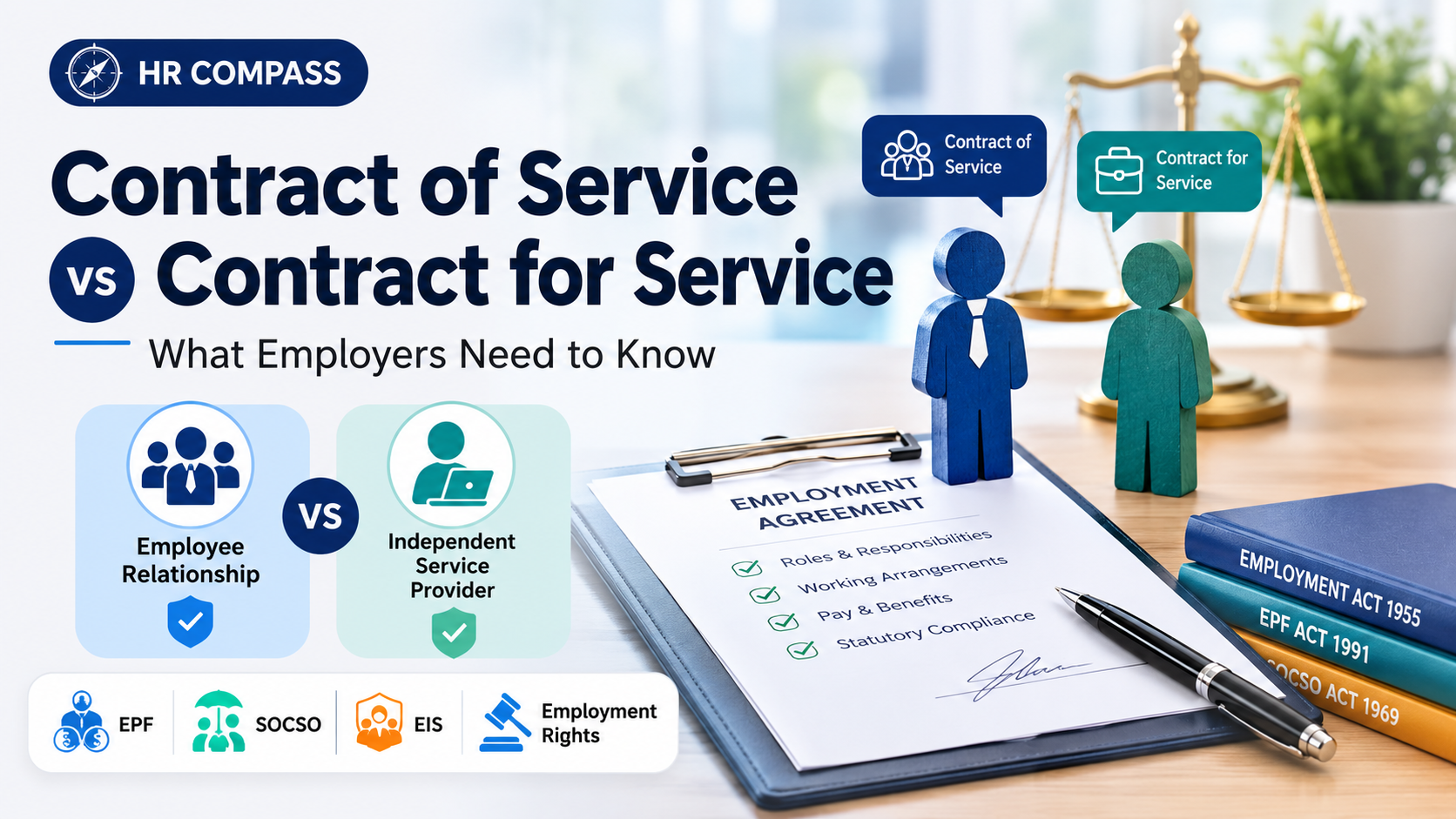
Contract of Service vs Contract for Service : What Employers Need to Know
Employment Classification Guide Series
Understanding a person's employment status is important because it can affect statutory contributions, employment rights and employer responsibilities.
- Part 1: Contract of Service vs Contract for Service in Malaysia
- Part 2: Intern vs Apprentice in Malaysia: What's the Difference?
- Part 3: Malaysia Internship Guide (2026): Allowance, EPF, SOCSO, EIS & Employment Rights
- Part 4: Malaysia Apprentice Guide (2026): EPF, SOCSO, EIS & Employment Rights
You're currently reading: Part 1 – Contract of Service vs Contract for Service
At a Glance
| Question | Contract of Service | Contract for Service |
|---|---|---|
| Relationship | Employer–employee | Client–independent service provider |
| Main purpose | Employee works for the employer | Independent party provides an agreed service |
| Control and supervision | Employer generally exercises control over the work | Service provider is generally free from the client's control and monitoring |
| Can it be verbal? | Yes — it may be written, oral, express or implied | Depends on the agreed service arrangement |
| EPF | Mandatory where the person is an employee under a Contract of Service, subject to the EPF Act and applicable exemptions | Generally not treated as mandatory employee EPF |
| SOCSO | Eligible employees under a Contract of Service are covered | Independent/self-employed persons do not fall under ordinary employee coverage |
| EIS | Generally applies to eligible employees | Generally does not apply to genuinely self-employed persons |
| Employment Act | May apply where an employment relationship exists | Generally not an employer–employee relationship |
What Is a Contract of Service?
A Contract of Service creates an employer & employee relationship.
KWSP defines a Contract of Service as an agreement where one person agrees to employ another person as an employee and the other person agrees to serve the employer as an employee.
The agreement may be:
- written;
- oral;
- express; or
- implied.
In simple terms:
Contract of Service = “I work for you as your employee.”
This classification matters because statutory obligations such as EPF, SOCSO and EIS generally depend on whether the individual is an employee under a Contract of Service or Apprenticeship, subject to the requirements and exemptions under the relevant legislation.
What Is a Contract for Service?
A Contract for Service is an arrangement where an independent person or business agrees to provide a service to another party.
KWSP describes a Contract for Service as an arrangement where the person providing the service is generally free from the control and monitoring of the person or organisation receiving the service.
In simple terms:
Contract for Service = “You hire me to provide a service, but I am not your employee.”
A genuinely independent freelancer, consultant or service provider may operate under a Contract for Service, depending on the actual working relationship.
Key Differences
| Area | Contract of Service | Contract for Service |
| Employer & employee relationship | Yes | Generally no |
| Work is performed as an employee | Yes | Independent service |
| Control over work | Employer normally exercises greater control | Service provider generally operates more independently |
| Working hours | Often determined by employer | Usually determined more independently |
| Tools / equipment | Often provided by employer | Often provided by service provider |
| Payment | Salary / wages | Service fee / project fee |
| EPF | Mandatory where statutory requirements are met | Generally not mandatory as employee EPF |
| SOCSO | Eligible employees are covered | Separate self-employment coverage may apply |
| EIS | Generally applies to eligible employees | Generally excluded for genuine self-employment |
| Employment Act rights | May apply | Generally do not arise from an employment relationship |
KWSP defines an employee as a person employed under a Contract of Service or Apprenticeship, while PERKESO likewise bases ordinary employee coverage on a Contract of Service or Apprenticeship.
How Do You Know Whether Someone Is Really an Employee?
The label written on a contract is not the only relevant consideration.
Where there is no written Contract of Service, Section 101C of the Employment Act 1955 allows certain factors to be used as a statutory presumption of an employee–employer relationship in proceedings under the Act.
Relevant indicators include whether:
| Indicator | What It Means |
| The way the work is performed is controlled by another person | Someone determines how the worker should carry out the work |
| Working hours are controlled by another person | The organisation determines when the person must work |
| Tools, materials or equipment are provided by another person | The worker relies on resources supplied by the organisation |
| The work forms an integral part of another person's business | The worker's duties are integrated into the organisation's business |
| The work is performed mainly for another person's benefit | The services primarily benefit one organisation |
| Regular payments form the majority of the person's income | The worker is financially dependent on the organisation |
These factors are particularly relevant where there is no written employment contract and the actual nature of the relationship needs to be determined.
Simple Scenario 1 : Employee
A company hires Sarah as an HR Executive.
She:
- works according to company working hours;
- reports to an HR Manager;
- performs ongoing duties within the HR team;
- uses the company's laptop and systems;
- receives a fixed monthly salary.
This arrangement is consistent with an employer–employee relationship and would normally be structured under a Contract of Service.
Simple Scenario 2 : Independent Service Provider
A company hires a freelance designer to create a new corporate brochure.
The designer:
- determines when and where the work is performed;
- uses their own equipment;
- charges an agreed project fee;
- provides services to multiple clients;
- is responsible for delivering an agreed final result rather than working as part of the company's daily organisation.
This arrangement is more consistent with a Contract for Service.
Does Calling Someone a “Freelancer” Automatically Make Them One?
No.
The label used in an agreement is not the only relevant consideration.
If a person is described as a freelancer or contractor but the actual arrangement operates like employment , for example, the company controls the person's working hours, work methods and day-to-day duties , the legal relationship may need to be assessed based on the applicable legislation and the actual facts.
HR should therefore look at how the relationship works in practice, not only the job title or contract heading.
Why Does the Difference Matter?
Correct classification can affect several important statutory and HR obligations.
| Area | Why Classification Matters |
| EPF | Employers generally must contribute for employees engaged under a Contract of Service or Apprenticeship |
| SOCSO | Eligible employees under a Contract of Service or Apprenticeship must be registered and covered |
| EIS | Eligible employees generally fall within EIS coverage |
| Employment Act | Statutory employment rights depend on whether an employment relationship exists and the relevant provisions apply |
| Payroll | Employees are normally processed through payroll; independent service providers are usually paid against invoices or service arrangements |
| Leave & working hours | Statutory leave, working-hour and other employee protections generally relate to employment relationships |
| HR policies | Employee disciplinary procedures and internal HR policies generally apply to employees rather than independent service providers |
PERKESO states that principal employers employing employees under a Contract of Service or Apprenticeship are responsible for registration and contributions under the applicable SOCSO and EIS legislation.
Statutory Contributions at a Glance
| Statutory Item | Contract of Service | Contract for Service |
| EPF | Generally mandatory, subject to the EPF Act and applicable exemptions | Generally not mandatory as employee EPF |
| SOCSO | Required for eligible employees | Ordinary employee SOCSO generally does not apply; separate self-employment schemes may apply |
| EIS | Generally required for eligible employees | Generally does not apply to genuinely self-employed persons |
| Employment Act benefits | May apply | Generally not applicable as employee rights |
Important: Classification depends on the actual legal relationship. Calling a payment a “service fee” or calling someone a “contractor” does not automatically determine whether the relationship is employment or independent service.
HR Checklist
Before deciding whether a person should be engaged under a Contract of Service or Contract for Service:
- Check who controls the person's working hours.
- Check who controls how the work is carried out.
- Check who provides the tools and equipment.
- Determine whether the person's work forms part of the company's normal business operations.
- Consider whether the person independently provides services to multiple clients.
- Review how the person is paid — salary/wages or service/project fees.
- Check whether the person is financially dependent on the organisation.
- Review whether the relationship is ongoing employment or a defined independent service.
- Do not rely solely on labels such as “freelancer”, “consultant” or “contractor”.
Frequently Asked Questions
Can a Contract of Service be verbal?
Yes.
KWSP confirms that a Contract of Service may be written or oral, express or implied.
Is a fixed-term employee under a Contract of Service?
They can be.
A Contract of Service does not have to be permanent employment. An employee may be employed on a fixed-term, temporary or part-time basis and still be under a Contract of Service.
Is a freelancer always under a Contract for Service?
No.
A genuinely independent freelancer may operate under a Contract for Service, but the actual relationship should be assessed. Using the word “freelancer” does not by itself determine legal status.
Does a Contract for Service require EPF?
Generally, mandatory employee EPF contributions arise where a person is an employee under a Contract of Service or Apprenticeship, subject to the EPF Act.
A genuinely independent service provider would not normally fall within ordinary mandatory employee EPF coverage.
Does a Contract for Service require SOCSO or EIS?
Ordinary employee SOCSO and EIS coverage is generally tied to employment under a Contract of Service or Apprenticeship.
A genuinely self-employed or independent service provider may instead fall under separate statutory schemes where applicable.
Can a company simply issue a Contract for Service to avoid statutory contributions?
The contract label alone does not determine the legal relationship.
If the actual facts show an employer–employee relationship, the person's status may need to be assessed under the relevant legislation regardless of the title used in the agreement.
Key Takeaway
A Contract of Service creates an employer & employee relationship, while a Contract for Service generally involves an independent service provider.
The distinction should not be determined by the contract title alone. HR should consider the actual working relationship, including control over the work, working hours, equipment, business integration, payment structure and economic dependence.
Correct classification is important because it can directly affect EPF, SOCSO, EIS, Employment Act rights, payroll processing and other employer obligations.