
Employee Leaving Checklist in Malaysia: What HR Must Do for Payroll, EPF, PERKESO and LHDN
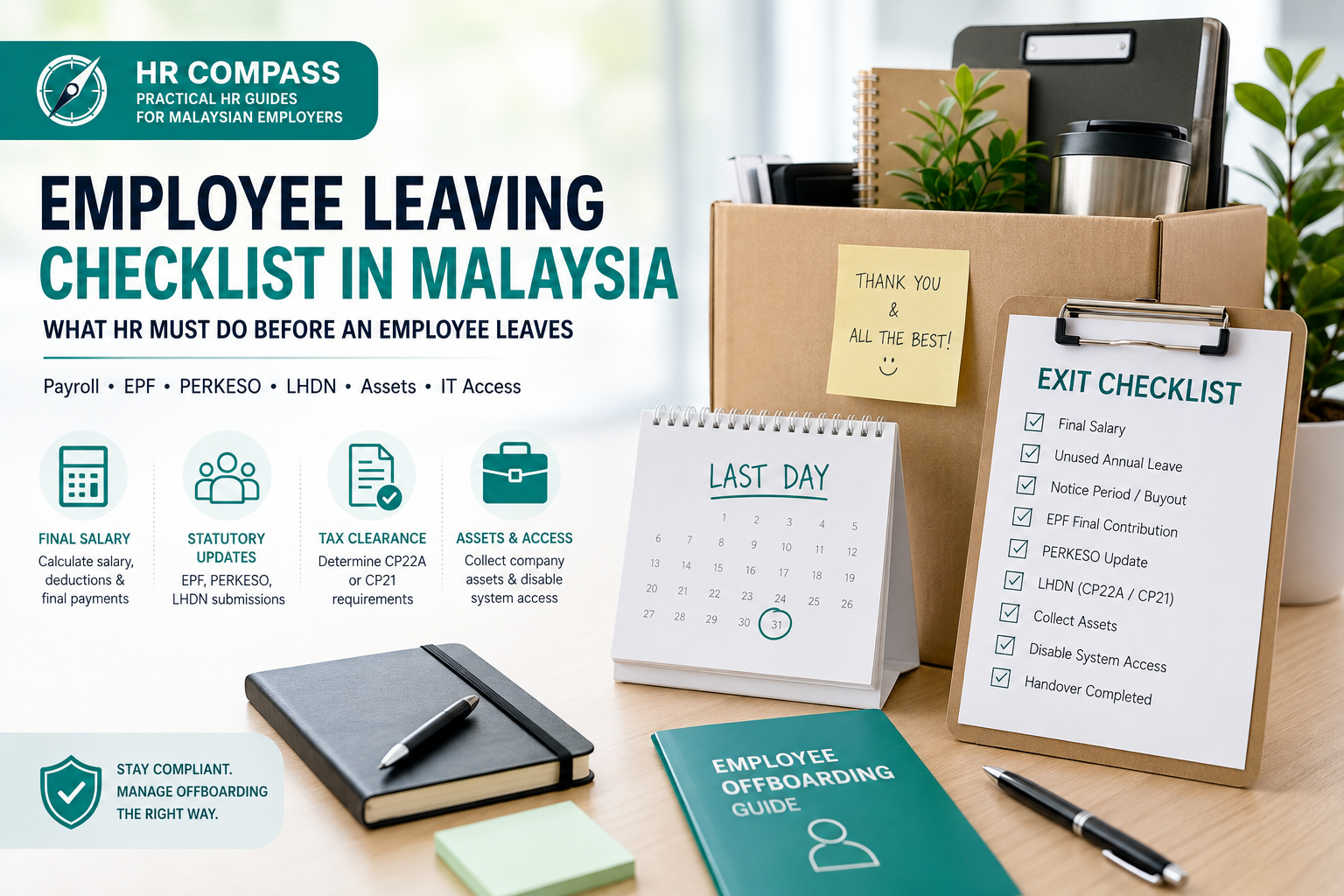
Quick Summary
When an employee resigns, retires, is terminated or leaves the company for any reason, HR has more responsibilities than simply processing the employee's final salary.
Employers may need to:
- Calculate the employee's final salary and statutory payments
- Process EPF contributions
- Update PERKESO records
- Determine whether LHDN tax clearance is required
- Recover company assets
- Disable system access
- Complete employee offboarding documentation
This guide explains the essential HR checklist for employee offboarding in Malaysia.
At a Glance
| Area | HR Action |
|---|---|
| Final Salary | Calculate salary, deductions and final payments |
| Notice Period | Check notice served or payment in lieu / buyout |
| Annual Leave | Pay earned but unused annual leave where applicable |
| EPF | Process final EPF contribution |
| PERKESO | Update employee resignation date |
| LHDN | Assess whether CP22A or CP21 is required |
| Assets | Collect company property |
| IT | Disable system access |
1. Confirm the Employee's Last Working Day
Before processing the resignation, HR should confirm:
- Last working day
- Employment end date
- Notice period
- Whether notice has been fully served
- Outstanding annual leave
- Claims or commissions
- Company assets issued
- Whether the employee will leave Malaysia
These dates should be consistent across:
- Payroll
- Attendance records
- HR system
- Resignation letter
- LHDN submissions (where applicable)
2. Calculate the Final Salary
Where employment ends before the end of the salary period, the Employment Act 1955 provides the following formula for calculating wages for an incomplete month:
Monthly Salary ÷ Number of Days in the Wage Period × Number of Days Worked
Example
Encik Ali
Monthly Salary:
RM6,000
Last Working Day:
20 August
August has 31 days.
Calculation:
RM6,000 ÷ 31 × 20
= RM3,870.97
Besides salary, HR should also review:
| Payroll Item | Required |
|---|---|
| Salary up to last working day | ✅ |
| Unused Annual Leave | ✅ |
| Approved Expense Claims | ✅ |
| Commission / Incentive | ✅ |
| Bonus (if applicable) | Check company policy |
| Notice Buyout / Payment in Lieu | Where applicable |
| Lawful Deductions | Where permitted |
3. Check Notice Period, Payment in Lieu & Notice Buyout
HR should review the employment contract and determine whether the employee:
- completed the contractual notice period;
- is being released early by mutual agreement;
- is required to make a notice buyout (payment in lieu of notice);
- will receive payment in lieu of notice from the employer; or
- has any lawful deductions relating to the notice period.
Example
Encik Ali is required to serve 2 months' notice, but he wishes to leave after serving only 1 month.
If the employer agrees to an early release, the remaining 1 month's notice may be settled through a notice buyout, subject to the employment contract or a written agreement.
HR Tip: Do not automatically deduct notice buyout from the employee's final salary without a contractual or legal basis.
4. Review Unused Annual Leave
Before processing the final payroll, HR should review the employee's annual leave balance.
Under the Employment Act 1955, where an employee's employment is terminated and the employee has earned but not taken statutory annual leave, the employer is generally required to pay wages in lieu of the unused annual leave.
HR should review:
- Annual leave entitlement
- Leave taken during notice period
- Negative leave balance
- Contractual annual leave benefits beyond the statutory minimum
Example
Encik Jason
Annual Leave Entitlement:
12 days
Unused Annual Leave:
5 days
Monthly Salary:
RM3,120
Company payroll calculation basis:
26 days
Daily Rate
RM3,120 ÷ 26
= RM120.00
Unused Annual Leave Payment
RM120 × 5
= RM600.00
This amount should generally be included in the employee's final payroll.
Note: The calculation basis (26 days, Actual Calendar Days, or another contractual method) should follow the applicable law, employment contract and company policy.
5. Process the Final EPF Contribution
For an employee leaving the company, employers generally do not need to submit a resignation form to KWSP.
HR should:
- Include all EPF-liable wages in the employee's final contribution
- Submit contributions within the statutory deadline
- Stop future contributions after employment ends
- Keep payroll and contribution records
6. Update PERKESO (SOCSO & EIS)
After the employee leaves, HR should update the employee's resignation date through the PERKESO ASSIST Portal.
General process:
- Login to ASSIST Portal
- Select My Sites
- Registration
- Update
- Update Employee Resigned Date
- Select employee
- Enter resignation date
- Save
This keeps the employee contribution records accurate.
7. Determine Whether CP22A Is Required
Not every resignation requires CP22A.
For employees who fall within LHDN's tax clearance requirements, employers should submit CP22A through MyTax e-SPC.
Submission should generally be made:
- At least 30 days before the employee's cessation date; or
- Within 30 days after the employer is informed of the employee's death.
CP22A may not be required if:
- The employee is subject to Monthly Tax Deduction (PCB); or
- The employee's remuneration is below the PCB threshold.
Always refer to the latest LHDN guidance before submission.
8. Determine Whether CP21 Is Required
CP21 is different from CP22A.
CP21 applies when an employee intends to leave Malaysia for more than three months.
Where applicable, employers should submit CP21 through MyTax e-SPC at least 30 days before the employee's expected departure.
9. Tax Clearance & Final Payment
Where tax clearance applies, employers may be required to withhold monies payable to the employee, including:
- Salary
- Bonus
- Commission
- Gratuity
- Compensation
- Other final payments
until:
- LHDN issues tax clearance; or
- The statutory withholding period expires.
Do not automatically withhold payments for every departing employee. This requirement applies only where tax clearance is required.
10. Collect Company Assets
Before the employee leaves, ensure all company property is returned.
Typical assets include:
- Laptop
- Charger
- Mobile Phone
- Access Card
- Office Keys
- Security Token
- Company Credit Card
- Documents
- Uniforms
- Other Company Equipment
HR should obtain a signed asset return acknowledgement.
11. Disable System Access
Coordinate with IT to:
- Disable email
- Disable HRMS access
- Disable payroll access
- Disable finance systems
- Remove VPN access
- Transfer work ownership
- Redirect important emails
- Remove user from internal groups
HR Exit Checklist
Employment & Payroll
☑ Confirm final working day
☑ Review notice period
☑ Process notice buyout or payment in lieu (where applicable)
☑ Calculate incomplete-month salary
☑ Calculate and pay earned but unused annual leave
☑ Process bonus, commission and claims
☑ Prepare final payslip
Statutory
☑ Final EPF contribution
☑ Update PERKESO ASSIST
☑ Determine whether CP22A is required
☑ Determine whether CP21 is required
☑ Submit through MyTax e-SPC where applicable
☑ Keep statutory acknowledgement records
Administration
☑ Collect company assets
☑ Disable system access
☑ Conduct handover
☑ Update employee records
☑ Conduct exit interview (if applicable)
Official Resources
| Resource | Purpose |
|---|---|
| MyTax e-SPC | CP21 & CP22A submission |
| PERKESO ASSIST Portal | Update employee resignation date |
| KWSP Employer Portal | EPF employer services |
| Employment Act 1955 | Final salary, annual leave & notice requirements |
Frequently Asked Questions
Does every employee require CP22A?
No. Employers should first determine whether the employee falls within LHDN's tax clearance requirements.
Can annual leave replace the notice period?
Not automatically.
Whether annual leave can offset the contractual notice period depends on the employment contract, company policy and mutual agreement between the employer and employee.
Can the employee buy out the notice period?
Yes, if permitted under the employment contract or agreed by both parties. The buyout amount is usually equivalent to the salary for the unserved notice period.
Do employers need to notify KWSP when one employee resigns?
Generally, no. Employers simply process the employee's final EPF contribution and cease future contributions after employment ends.
Should PERKESO be updated?
Yes. HR should update the employee's resignation date through the PERKESO ASSIST Portal.
Key Takeaway
Employee offboarding is more than processing a resignation letter. HR should ensure the employee's final salary, notice obligations, annual leave, statutory contributions, tax clearance, company assets and system access are all managed accurately and in accordance with Malaysian employment laws.
Using a structured exit checklist helps employers stay compliant, reduce administrative errors and provide a smooth and professional offboarding experience.