
Form TP1 Explained (2026): Employee Tax Relief Declaration Guide
Malaysia Payroll Tax Guide Series
Whether you're an HR professional, payroll administrator or employee, this series explains Malaysia's payroll tax requirements from tax reliefs to Monthly Tax Deduction (PCB).
- Part 1: Malaysia Income Tax Relief Guide (2026): Complete List of Tax Reliefs & Deductions
- Part 2: Form TP1 Explained (2026): Employee Tax Relief Declaration Guide
- Part 3: Form TP3 Explained (2026): Previous Employment Information
- Part 4: Malaysia PCB (MTD) Guide (2026): Monthly Tax Deduction Explained
- Part 5: Tax Exempt Benefits in Malaysia (2026)
You're currently reading: Part 2 – Form TP1 Explained
At a Glance
| Question | Answer |
|---|---|
| What is TP1? | Employee declaration form for tax reliefs, deductions and rebates. |
| Who issues it? | Inland Revenue Board of Malaysia (LHDN). |
| Who submits it? | Employee. |
| Who receives it? | Employer / HR / Payroll. |
| Purpose | To update eligible tax reliefs for Monthly Tax Deduction (PCB). |
| Is it mandatory? | No. |
| Can it reduce monthly PCB? | Yes, if eligible reliefs are declared and processed. |
| Can it be submitted more than once? | Yes, whenever new eligible tax reliefs arise during the year. |
| Does it replace annual tax filing? | No. Employees must still file their Income Tax Return if required. |
| Supporting documents required? | Yes, where applicable. |
| Legal Reference | Income Tax (Deduction from Remuneration) Rules & LHDN PCB Specification. |
Quick Summary
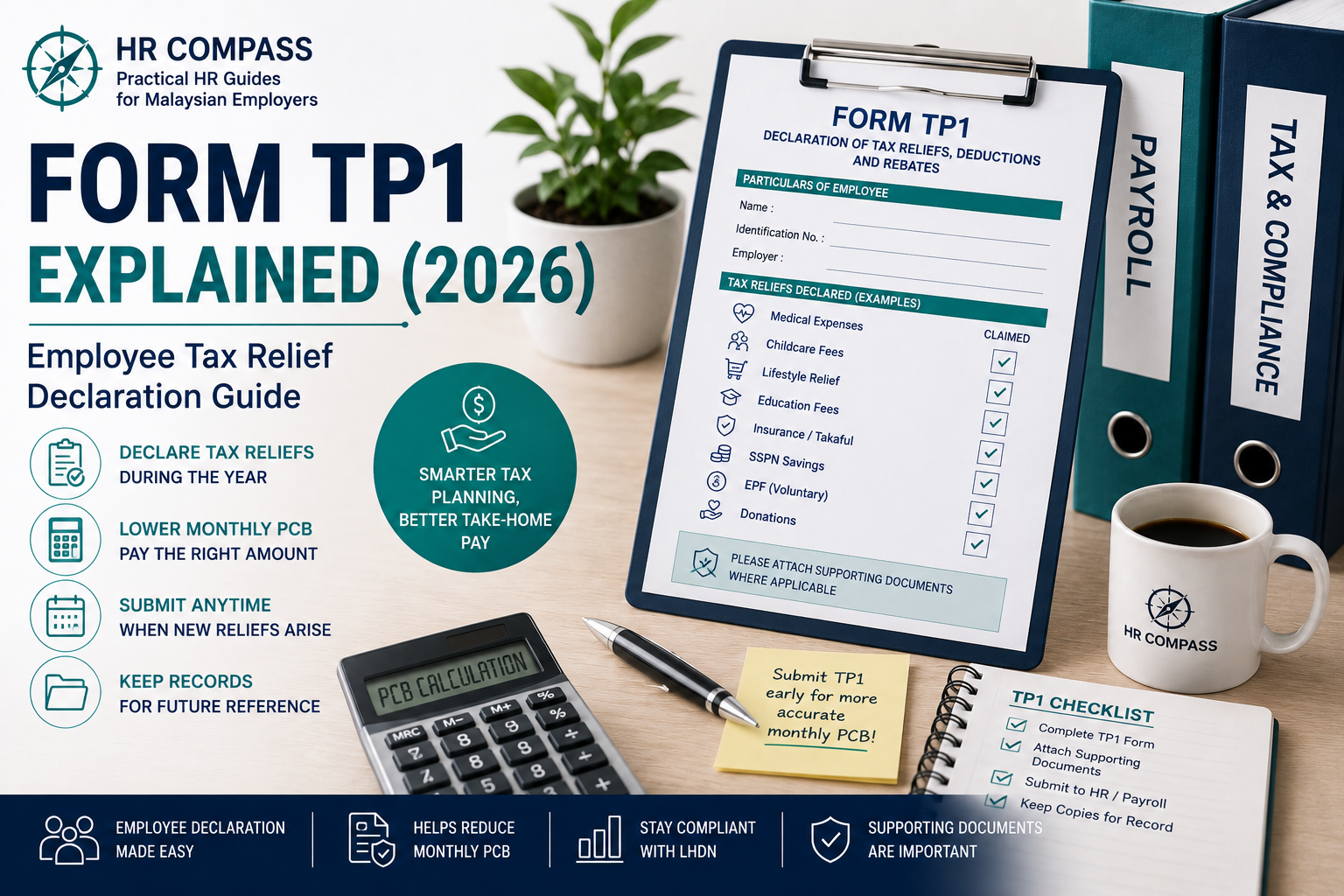
Form TP1 is an official declaration form issued by LHDN that allows employees to declare eligible tax reliefs, deductions and rebates during the year.
Instead of waiting until the annual income tax filing, employees may submit Form TP1 to their employer so that payroll can take eligible tax reliefs into account when calculating the Monthly Tax Deduction (PCB/MTD).
This guide explains:
- What Form TP1 is
- Who should submit it
- When it should be submitted
- How it affects payroll
- HR responsibilities
- Frequently asked questions
What Is Form TP1?
Form TP1 is an official declaration form issued by LHDN that allows employees to notify their employer of eligible tax reliefs, deductions and rebates which may affect their Monthly Tax Deduction (PCB/MTD).
The purpose of Form TP1 is to help payroll calculate a more accurate monthly PCB based on the employee's current tax reliefs, rather than waiting until the annual income tax filing.
Important: Form TP1 does not replace the annual Income Tax Return.
Why Should Employees Submit Form TP1?
Without Form TP1
Employee incurs eligible tax reliefs
↓
Payroll calculates PCB using the existing employee information
↓
Monthly PCB may be higher than necessary
↓
Employee waits until annual tax filing to claim the relief
With Form TP1
Employee incurs eligible tax reliefs
↓
Employee submits Form TP1
↓
Payroll updates the PCB calculation
↓
Monthly PCB may be reduced
↓
Employee pays a more accurate amount of monthly tax
Who Should Submit Form TP1?
Employees who incur new qualifying tax reliefs during the year may consider submitting Form TP1.
Examples include:
- Medical expenses
- Childcare fees
- Education fees
- Lifestyle purchases
- Life insurance or takaful
- SSPN savings
- Voluntary EPF contributions
- Other qualifying tax reliefs announced by LHDN
For the complete list of available tax reliefs, refer to Part 1 – Malaysia Income Tax Relief Guide (2026): Complete List of Tax Reliefs & Deductions.
When Should Form TP1 Be Submitted?
LHDN does not prescribe a fixed annual submission deadline.
Employees should submit Form TP1 as soon as they incur eligible tax reliefs, allowing payroll to consider them in subsequent PCB calculations.
Employers may also establish internal payroll cut-off dates for processing TP1 submissions.
Can Employees Submit Form TP1 More Than Once?
Yes.
Employees may submit an updated Form TP1 whenever they incur additional qualifying tax reliefs during the year.
Example
January
Purchased a qualifying laptop.
↓
April
Started paying registered childcare fees.
↓
August
Paid tuition fees for an approved professional qualification.
Each of these may justify a new TP1 submission, subject to eligibility and the employer's payroll processing schedule.
Supporting Documents
Employees should retain supporting documents for all tax reliefs claimed.
Common examples include:
- Official receipts
- Tax invoices
- Insurance premium statements
- Medical bills
- Childcare fee receipts
- SSPN statements
- Education fee receipts
- Donation receipts
LHDN may request these documents during a tax audit.
How Form TP1 Affects Payroll
The payroll process typically follows these steps:
Employee incurs an eligible tax-relief expense
↓
Employee completes Form TP1
↓
Employee submits supporting documents
↓
HR or Payroll verifies the declaration
↓
Payroll updates the payroll system
↓
Monthly PCB is recalculated
↓
Employee receives the updated PCB deduction
HR Best Practices
Before processing Form TP1:
☑ Verify supporting documents.
☑ Check that the relief qualifies under the applicable Year of Assessment (YA).
☑ Ensure the claim does not exceed the allowable limit.
☑ Update the payroll system before payroll processing.
☑ Keep the declaration and supporting documents for record-keeping purposes.
☑ Inform employees that Form TP1 does not replace the annual income tax filing.
Common Mistakes
Waiting until year-end
Many employees only claim tax reliefs during annual tax filing.
Submitting Form TP1 earlier may help reduce Monthly Tax Deduction (PCB) during the year.
Assuming every tax relief can be declared through TP1
Not every relief is declared through payroll.
Employees should refer to the latest LHDN guidance and the eligible TP1 categories.
Throwing away receipts
Submitting Form TP1 does not remove the need to retain supporting documents.
Employees remain responsible for keeping their records if requested by LHDN.
Frequently Asked Questions
Is Form TP1 compulsory?
No.
Employees are not required to submit Form TP1.
Can Form TP1 reduce my income tax?
Not directly.
Form TP1 may reduce the Monthly Tax Deduction (PCB), but the final tax liability is determined when the annual Income Tax Return is filed.
Can employers reject Form TP1?
Employers should review the declaration and supporting documents before updating payroll. Additional documents may be requested where necessary.
Can I submit Form TP1 every month?
Yes.
Employees may submit an updated Form TP1 whenever there are new qualifying tax reliefs, subject to the employer's payroll cut-off dates.
Do I still need to file my Income Tax Return?
Yes.
Form TP1 only assists with Monthly Tax Deduction (PCB) calculations and does not replace the annual income tax filing.
HR Checklist
☑ Verify supporting documents.
☑ Confirm eligibility under the current Year of Assessment (YA).
☑ Update the payroll system before payroll processing.
☑ Retain Form TP1 and supporting documents.
☑ Inform employees of the payroll cut-off date.
☑ Remind employees that TP1 does not replace the annual tax return.
Key Takeaway
Form TP1 provides employees with an opportunity to declare eligible tax reliefs, deductions and rebates during the year, allowing payroll to calculate a more accurate Monthly Tax Deduction (PCB). While submitting TP1 may reduce monthly tax deductions, it does not replace the annual income tax filing, and employees should continue to retain supporting documents for all claims.