
Malaysia Overtime Pay Guide: OT Rates & Calculation Under the Employment Act 1955
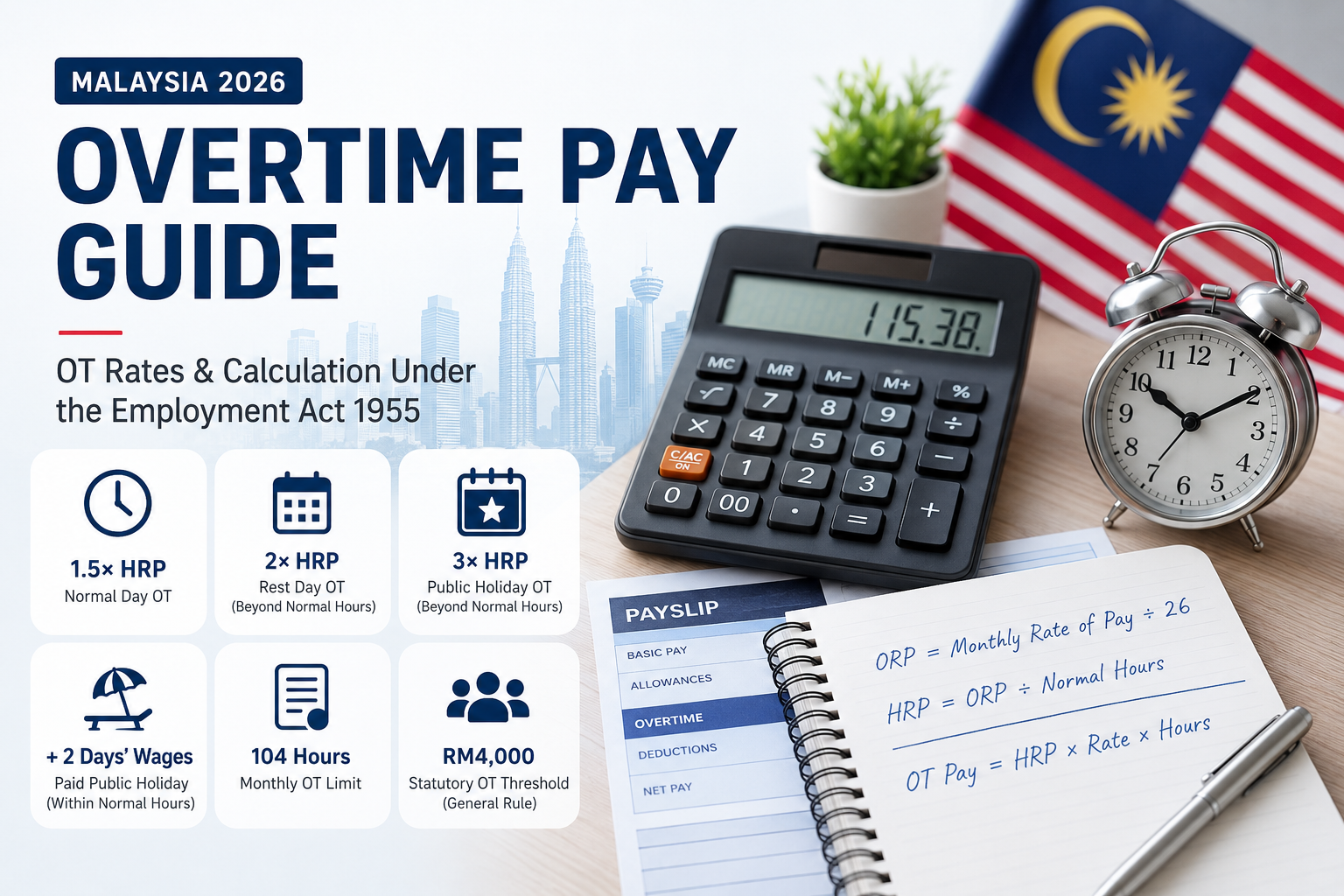
At a Glance
| Question | Answer |
|---|---|
| What counts as overtime? | Work performed beyond an employee's normal hours of work per day |
| Normal working-day OT | At least 1.5× Hourly Rate of Pay (HRP) |
| Rest-day work | ½ ORP / 1 ORP / 2× HRP, depending on hours worked |
| Paid public holiday | Additional 2 days' wages for work within normal hours |
| Public-holiday OT | At least 3× HRP for hours beyond normal hours |
| Monthly OT limit | 104 hours, subject to statutory rules and exceptions |
| Main statutory OT coverage | Generally employees earning RM4,000/month or less, plus specified categories regardless of wages |
| Main law | Employment Act 1955 |
Scope: This guide covers the Employment Act 1955 framework applicable in Peninsular Malaysia and the Federal Territory of Labuan.
Who Is Entitled to Statutory Overtime Pay?
The Employment Act 1955 generally covers employees under a contract of service, but not every employee has the same statutory entitlement to overtime, rest-day and public-holiday payments.
Employees earning RM4,000 per month or less are generally covered by these statutory payment provisions.
Employees earning more than RM4,000 are generally excluded from the relevant statutory OT, rest-day and paid-holiday payment provisions unless they fall within specified categories covered regardless of wages, including certain employees engaged in manual labour.
JTKSM's current guidance similarly states that employees earning more than RM4,000, except manual employees, are not eligible to claim statutory overtime, rest-day and paid-holiday payments.
Therefore, don't simply assume:
Salary above RM4,000 = No OT
An employee may still fall within a category covered regardless of wages. Employees outside the statutory OT provisions may also receive OT under their employment contract, company policy or collective agreement.
Normal Working Hours
Under Section 60A of the Employment Act 1955, an employee generally cannot be required to work:
- more than 5 consecutive hours without at least a 30-minute break;
- more than 8 hours in one day;
- over a spread of more than 10 hours in one day; or
- more than 45 hours in one week.
The Act contains exceptions and special arrangements for certain circumstances.
For OT purposes, the important concept is the employee's normal hours of work. Overtime generally refers to hours worked beyond the normal daily hours agreed under the contract of service.
This means OT does not necessarily start only after 8 hours. The employee's agreed normal hours of work must first be identified, subject to the limits prescribed under Section 60A of the Employment Act 1955.
Maximum Overtime: 104 Hours Per Month
The Employment (Limitation of Overtime Work) Regulations 1980 prescribe a maximum of 104 hours of overtime in any one month.
For this specific 104-hour limit, work performed on a rest day or paid public holiday is not counted as "overtime work" for the purpose of that statutory limit. The law also provides a mechanism for permission to exceed the prescribed limit in applicable circumstances.
How to Calculate Overtime
For a monthly-rated employee, start with two calculations.
Step 1 — Ordinary Rate of Pay (ORP)
ORP = Monthly Rate of Pay ÷ 26
Step 2 — Hourly Rate of Pay (HRP)
HRP = ORP ÷ Normal Hours of Work per Day
Example Used Throughout This Guide
Let's use the same employee throughout the examples:
| Item | Calculation |
|---|---|
| Monthly Rate of Pay | RM3,000 |
| Normal Working Hours | 8 hours/day |
| ORP | RM3,000 ÷ 26 = RM115.38 |
| HRP | RM115.38 ÷ 8 = RM14.42 |
Figures shown are rounded to two decimal places. Actual payroll calculations may differ slightly depending on when rounding is applied.
Can an Employer Use 22 Days Instead of 26?
The statutory baseline for a monthly-rated employee is:
Monthly rate of pay ÷ 26
However, Section 60I permits another method or formula provided that the resulting Ordinary Rate of Pay is not lower than the statutory rate.
For example, an employer may use a more favourable divisor such as 22 days where it produces a higher ORP for the employee.
For a straightforward statutory calculation, 26 remains the standard baseline.
Scenario 1: Overtime on a Normal Working Day
For hours worked beyond normal working hours:
OT Pay = HRP × 1.5 × OT Hours
The statutory rate is not less than 1.5× HRP.
Example
Our employee works 2 additional hours after completing the normal workday.
RM14.42 × 1.5 × 2
= approximately RM43.27
OT Pay: RM43.27
Scenario 2: Working on a Rest Day
For a monthly- or weekly-rated employee, rest-day payment depends on how many hours are worked.
| Hours Worked on Rest Day | Statutory Payment |
|---|---|
| Up to half the normal daily hours | ½ ORP |
| More than half but not exceeding normal daily hours | 1 ORP |
| Beyond normal daily hours | 2× HRP per excess hour, in addition to the applicable rest-day payment |
Example A — Works 4 Hours
Normal workday = 8 hours.
4 hours is half the normal workday.
½ × RM115.38 = RM57.69
Rest-day payment: RM57.69
Example B — Works 6 Hours
6 hours is more than half but does not exceed the normal 8-hour workday.
1 × RM115.38 = RM115.38
Rest-day payment: RM115.38
Example C — Works 10 Hours
For the first 8 hours:
1 × ORP = RM115.38
For the additional 2 hours:
RM14.42 × 2 × 2
≈ RM57.69
Total:
RM115.38 + RM57.69
≈ RM173.08
Total rest-day payment: approximately RM173.08
The important distinction is that 2× HRP applies to the hours exceeding normal working hours, not automatically to every hour worked on the rest day.
Scenario 3: Working on a Paid Public Holiday
For an eligible employee who works on a paid public holiday during normal working hours, Section 60D provides an additional two days' wages at the Ordinary Rate of Pay, in addition to the holiday pay.
For a monthly-rated employee whose monthly wages are paid without reduction, the underlying holiday pay is already included in the monthly salary.
Example
Our employee works within the normal 8 hours on a paid public holiday.
Additional payment:
RM115.38 × 2 = RM230.77
Therefore:
Normal holiday pay → already included in monthly salary
Additional payment for working → RM230.77
This is why public-holiday work is sometimes described as "3× pay."
For payroll purposes, however, the more precise explanation is:
1× holiday pay already included in the monthly salary + additional 2× ORP for working on the holiday.
Scenario 4: Public Holiday + Overtime
If the employee continues working beyond normal hours on the paid public holiday, the excess hours are paid at:
Public Holiday OT = HRP × 3 × OT Hours
Example
Employee works:
8 normal hours + 2 additional hours
For working during the normal hours:
RM115.38 × 2 = RM230.77
For the additional 2 hours:
RM14.42 × 3 × 2
≈ RM86.54
Total additional payment:
RM230.77 + RM86.54
≈ RM317.31
Total additional payment: approximately RM317.31
The employee's normal holiday pay remains included in the monthly salary.
OT Calculation Quick Reference
| Situation | Statutory Calculation |
|---|---|
| Normal working day — beyond normal hours | 1.5× HRP per OT hour |
| Rest day — up to half normal daily hours | ½ ORP |
| Rest day — more than half but not exceeding normal hours | 1 ORP |
| Rest day — beyond normal hours | 2× HRP per excess hour |
| Paid public holiday — work within normal hours | Additional 2× ORP |
| Paid public holiday — beyond normal hours | 3× HRP per excess hour |
These distinctions matter because simply saying “normal day = 1.5×, rest day = 2×, public holiday = 3×” does not fully explain the statutory treatment of work performed within normal hours on rest days and public holidays.
What Counts as "Wages" for OT Calculation?
Another common mistake is automatically assuming that OT is always calculated from basic salary only.
For statutory purposes, the Employment Act has its own definition of wages. It generally includes basic wages and other cash payments payable for work done under the contract of service, subject to specific statutory exclusions.
Those exclusions include items such as:
- the value of accommodation and specified amenities or services;
- employer contributions to pension, provident or similar funds;
- travelling allowance or travelling concession;
- payments made to cover special expenses incurred because of employment;
- gratuity payable on discharge or retirement; and
- annual bonus.
Therefore, where an employee receives several remuneration components, HR should determine which components fall within the statutory definition of wages instead of automatically using either basic salary alone or every item appearing on the payslip.
What If the Employee Has Two Days Off?
If an employee receives more than one rest day in a week, the last of those rest days is treated as the statutory rest day for purposes of the relevant Employment Act provisions.
For example, if an employee has Saturday and Sunday off under such an arrangement:
Sunday is generally the statutory rest day.
This distinction matters because the other day off should not automatically be treated as another statutory rest day for the same calculation.
HR Checklist
Before processing overtime:
- Check whether the employee is covered by the statutory OT provisions.
- Confirm the employee's contractual normal working hours.
- Identify whether the work occurred on a normal working day, statutory rest day or paid public holiday.
- Determine the appropriate wages for ORP purposes.
- Calculate the employee's ORP and HRP.
- Apply the correct statutory payment rule.
- Maintain accurate attendance and overtime records.
- Monitor the applicable monthly overtime limit.
Frequently Asked Questions
Can an employer offer a higher OT rate?
Yes. The statutory OT rates are minimum requirements for employees covered by the relevant provisions. More favourable employment terms can be provided.
Can an employee earning more than RM4,000 still receive OT?
Yes.
Some categories of employees remain covered by the relevant statutory provisions regardless of wages. Other employees may also receive OT if their employment contract, company policy or collective agreement provides for it. JTKSM's current guidance confirms that the RM4,000 exclusion does not apply in the same way to manual employees.
Does working on any day off automatically make it a statutory rest day?
No.
Where an employee has more than one rest day in a week, the Employment Act contains a rule determining which day is treated as the statutory rest day. HR should therefore identify the designated statutory rest day rather than treating every non-working day identically.
Key Takeaway
For a monthly-rated employee, start with:
ORP = Monthly Rate of Pay ÷ 26
HRP = ORP ÷ Normal Hours of Work per Day
Then identify what type of day the employee worked. Normal working days, statutory rest days and paid public holidays each have different payment rules.
For HR, the most important thing is not to apply 1.5×, 2× and 3× blindly. First identify the employee's statutory coverage, normal working hours, statutory rest day and applicable wage basis, then apply the correct Employment Act calculation.