
Malaysia Benefits-in-Kind (BIK) Guide (2026)
Malaysia Payroll Tax Guide Series
Whether you're an HR professional, payroll administrator or employee, this series explains Malaysia's payroll tax requirements from tax reliefs to Monthly Tax Deduction (PCB).
- Part 1: Malaysia Income Tax Relief Guide (2026): Complete List of Tax Reliefs & Deductions
- Part 2: Malaysia Form TP1 Guide (2026): Employee Tax Relief Declaration
- Part 3: Malaysia Form TP3 Guide (2026): Previous Employment Information
- Part 4: Malaysia PCB (MTD) Guide (2026): Monthly Tax Deduction Explained
- Part 5: Malaysia EA Form Part F Guide (2026): Tax Exempt Allowances, Perquisites, Gifts & Benefits
- Part 6: Malaysia Benefits-in-Kind (BIK) Guide (2026)
- Part 7: Malaysia Perquisites Guide (2026)
You're currently reading: Part 6
At a Glance
| Question | Answer |
|---|---|
| What is a Benefit-in-Kind (BIK)? | A non-cash benefit provided by an employer to an employee because of employment. |
| Is BIK taxable? | Generally yes, unless specifically exempt under tax law. |
| Does BIK affect PCB? | Yes. Taxable BIK forms part of employment income and may affect Monthly Tax Deduction (PCB). |
| Who should read this guide? | HR professionals, Payroll administrators, Employers and Employees. |
| Official Source | LHDN Public Ruling No. 11/2019 – Benefits in Kind. |
Quick Summary
This guide explains:
- What a Benefit-in-Kind (BIK) is
- Common examples of BIK
- How BIK is valued
- Tax treatment of BIK
- Employer responsibilities
- Frequently asked questions
What is a Benefit-in-Kind (BIK)?
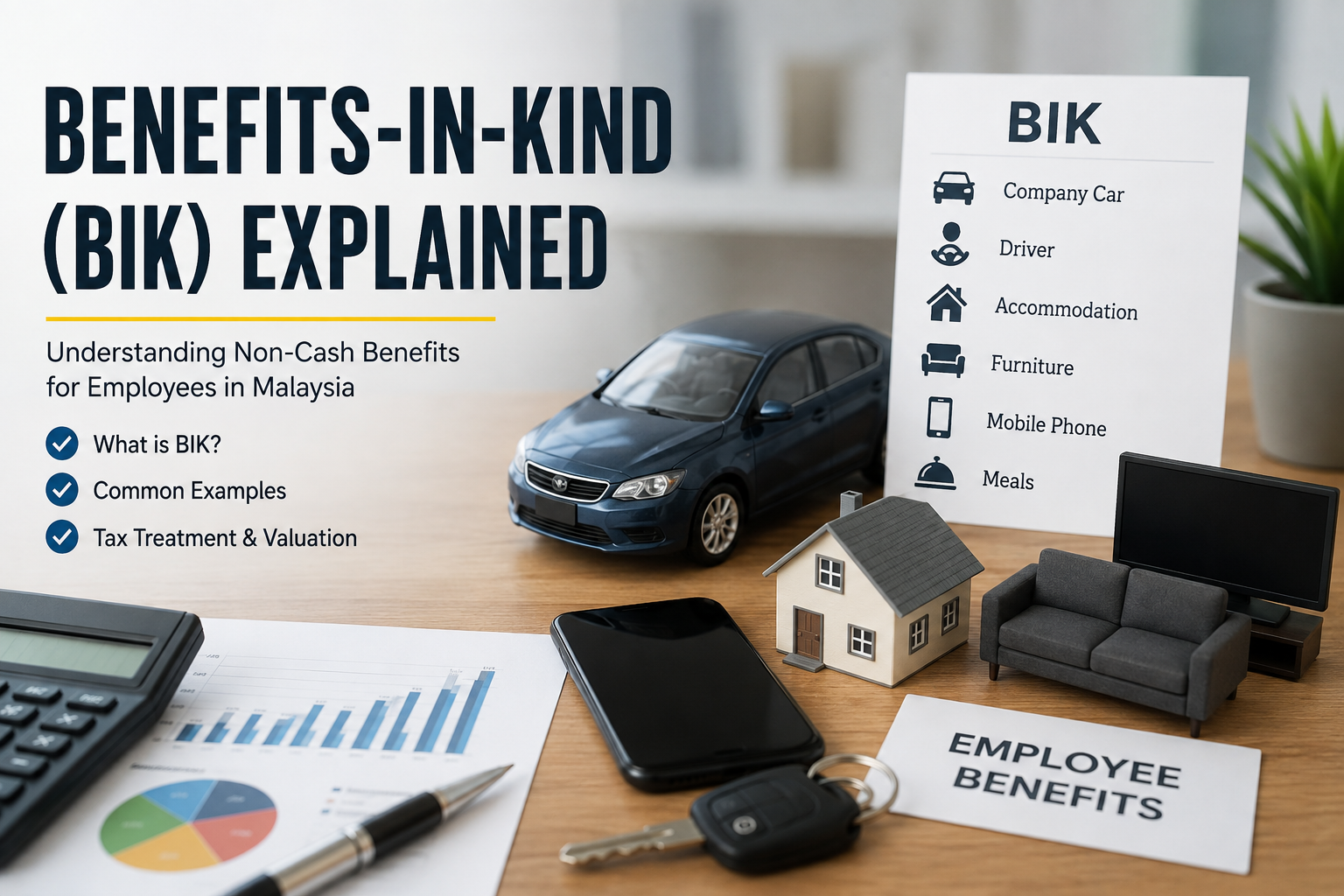
A Benefit-in-Kind (BIK) is a non-cash benefit provided by an employer to an employee because of employment.
Unlike salary or allowances, a BIK is usually provided in the form of goods, facilities or services instead of cash.
Examples include the private use of a company motor car, a driver provided by the employer, household furnishings and household appliances.
Common Benefits-in-Kind
The following are examples specifically covered in the LHDN Public Ruling.
| Benefit | Benefit-in-Kind? | Notes |
|---|---|---|
| Company motor car (private use) | ✅ | Private use of a company car is a taxable BIK. |
| Petrol provided together with the company car | ✅ | Taxable together with the motor car benefit. |
| Driver provided by employer | ✅ | Taxable BIK. |
| Domestic servant / maid | ✅ | Taxable BIK. |
| Household furnishings | ✅ | Includes furniture provided by the employer. |
| Household appliances | ✅ | Includes electrical appliances provided by the employer. |
| Household equipment | ✅ | Subject to the prescribed valuation rules. |
These are all specifically discussed in the Public Ruling.
Items That Are NOT Benefits-in-Kind
Some employment benefits are not classified as BIK because they are cash payments or benefits that are convertible into money.
| Item | BIK? | Explanation |
|---|---|---|
| Salary | ❌ | Cash remuneration |
| Bonus | ❌ | Cash remuneration |
| Commission | ❌ | Cash remuneration |
| Cash Allowance | ❌ | Treated as remuneration or perquisite |
| Overtime Payment | ❌ | Employment income |
| Incentive Payment | ❌ | Employment income |
These items are generally dealt with under remuneration or perquisites rather than Benefits-in-Kind.
How is a Benefit-in-Kind Valued?
The Public Ruling provides two official valuation methods.
| Method | When Used | Description |
|---|---|---|
| Formula Method | General method | Calculates the annual value based on the cost of the asset and its average lifespan. |
| Prescribed Value Method | Selected assets | Uses values prescribed by LHDN instead of calculating actual cost. |
The employer should apply the same valuation method consistently for the same asset throughout the period the benefit is provided.
Common BIK Valuation Methods
| Benefit | Formula Method | Prescribed Value Method |
|---|---|---|
| Motor Car | ✅ | ✅ |
| Petrol | Actual cost | Prescribed annual value |
| Driver | — | ✅ |
| Domestic Servant | — | ✅ |
| Household Furnishings | — | ✅ |
| Household Appliances | — | ✅ |
Does BIK Affect PCB?
Yes.
Taxable Benefits-in-Kind form part of an employee's employment income and should be included when determining taxable remuneration for payroll purposes.
Employers should ensure that the value of taxable BIK is correctly reflected when processing payroll and preparing the EA Form.
Employer Responsibilities
Employers should:
☑ Identify whether a benefit qualifies as a Benefit-in-Kind.
☑ Apply the correct valuation method.
☑ Maintain supporting records.
☑ Include taxable BIK in payroll records.
☑ Report the benefit correctly in the employee's EA Form.
HR Checklist
Before processing Benefits-in-Kind:
☑ Confirm the benefit is non-cash.
☑ Determine whether it is taxable or specifically exempt.
☑ Apply the correct valuation method.
☑ Keep supporting documents.
☑ Update payroll records accordingly.
Frequently Asked Questions
1. What is the difference between a Benefit-in-Kind and a cash allowance?
A Benefit-in-Kind is generally a non-cash benefit, while a cash allowance is employment income paid in cash.
2. Is a company car a Benefit-in-Kind?
Yes.
Private use of a company motor car is one of the most common examples of a taxable Benefit-in-Kind.
3. Is employer-provided petrol a Benefit-in-Kind?
Yes, where it is provided together with the company motor car as described in the Public Ruling.
4. Can employers choose any valuation method?
No.
The valuation method selected for an asset should be applied consistently throughout the period that benefit is provided.
5. Does BIK affect Monthly Tax Deduction (PCB)?
Yes.
Taxable Benefits-in-Kind form part of employment income and may affect PCB calculations.
6. Are all Benefits-in-Kind taxable?
Generally yes, unless a specific tax exemption applies under the Income Tax Act or relevant LHDN guidance.
Key Takeaway
Benefits-in-Kind (BIK) are non-cash benefits provided by an employer because of employment. Employers should correctly identify taxable BIK, apply the appropriate valuation method prescribed by LHDN, and report the value accurately for payroll and tax purposes. Understanding the distinction between BIK, remuneration and perquisites helps ensure compliance with Malaysia's income tax requirements.