
Malaysia Perquisites Guide (2026): What HR & Employers Need to Know
Malaysia Payroll Tax Guide Series
Whether you're an HR professional, payroll administrator or employee, this series explains Malaysia's payroll tax requirements from tax reliefs to Monthly Tax Deduction (PCB).
- Part 1: Malaysia Income Tax Relief Guide (2026): Complete List of Tax Reliefs & Deductions
- Part 2: Malaysia Form TP1 Guide (2026): Employee Tax Relief Declaration
- Part 3: Malaysia Form TP3 Guide (2026): Previous Employment Information
- Part 4: Malaysia PCB (MTD) Guide (2026): Monthly Tax Deduction Explained
- Part 5: Malaysia EA Form Part F Guide (2026): Tax Exempt Allowances, Perquisites, Gifts & Benefits
- Part 6: Malaysia Benefits-in-Kind (BIK) Guide (2026)
- Part 7: Malaysia Perquisites Guide (2026)
You're currently reading: Part 7
At a Glance
| Question | Answer |
|---|---|
| What is a Perquisite? | A benefit received because of employment that is paid in cash or has monetary value and can be converted into money. |
| Is a Perquisite taxable? | Generally yes, unless a specific exemption applies under the Income Tax Act or LHDN guidance. |
| Does it affect PCB (MTD)? | Yes. Taxable perquisites form part of employment income. |
| Official Source | LHDN Public Ruling No. 5/2019 – Perquisites From Employment |
| Who should read this? | HR professionals, Payroll administrators, Employers and Employees |
Quick Summary
This guide explains:
- What a perquisite is
- How it differs from a Benefit-in-Kind (BIK)
- Common examples recognised by LHDN
- Tax treatment
- Employer responsibilities
- Frequently asked questions
What Is a Perquisite?
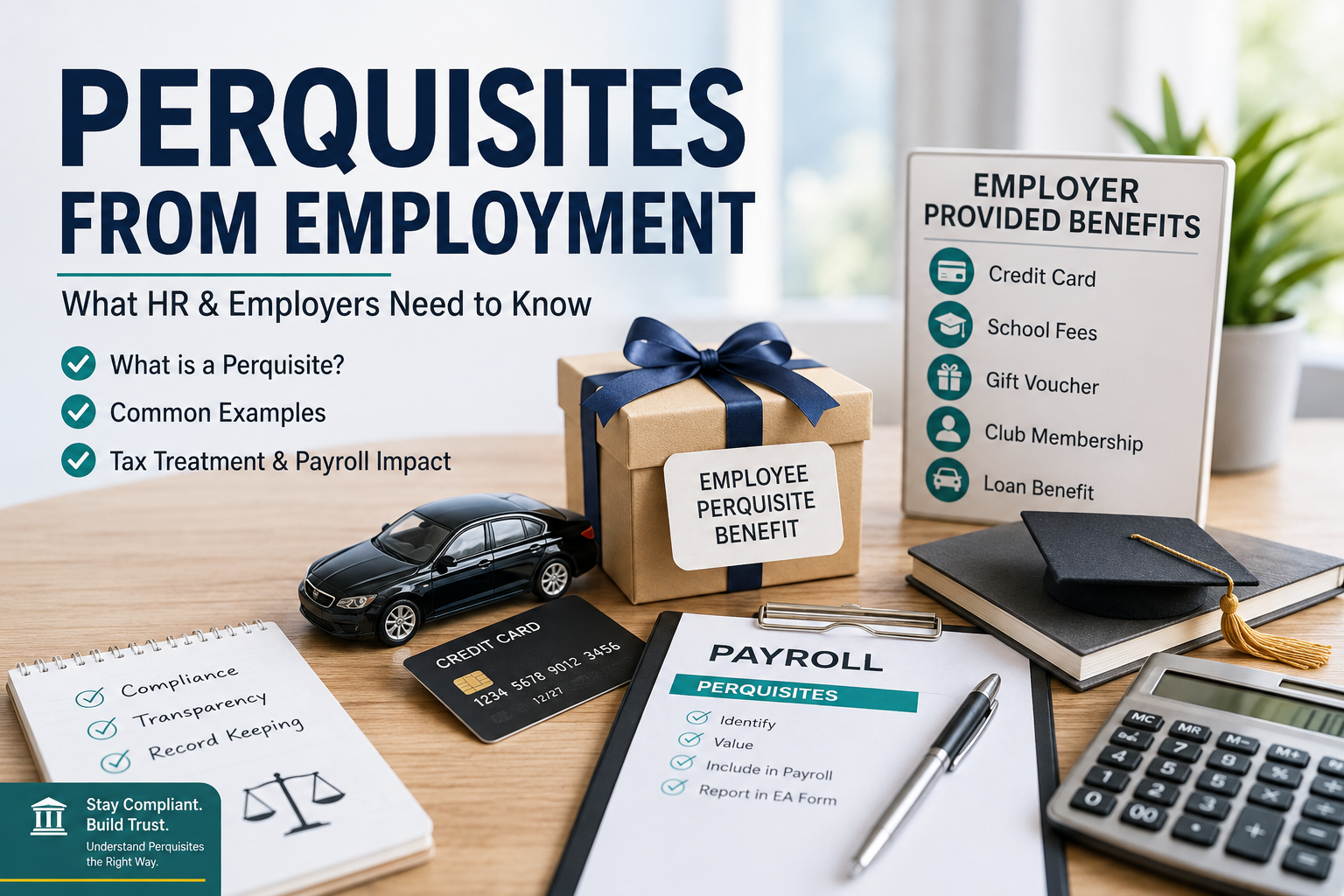
According to LHDN Public Ruling No. 5/2019, a Perquisite is a benefit received by an employee because of employment that:
- is paid in cash or
- is provided in a form that has monetary value and can be converted into money.
A perquisite may be provided directly by the employer or by a third party because of the employee's employment. Most perquisites are taxable unless a specific exemption applies.
Perquisite vs Benefit-in-Kind (BIK)
This is one of the most common areas of confusion.
| Perquisite | Benefit-in-Kind (BIK) |
|---|---|
| Cash or cash-equivalent benefit | Non-cash benefit |
| Has monetary value or can be converted into money | Usually goods, facilities or services provided for use |
| Governed by Public Ruling No. 5/2019 | Governed by Public Ruling No. 11/2019 |
| Example: Employer pays employee's personal income tax | Example: Company car provided for private use |
Common Perquisites Recognised by LHDN
Common Perquisites Recognised by LHDN
Note: Unless specifically stated otherwise, the perquisites listed below are generally taxable under the Income Tax Act 1967. The actual tax treatment may vary where a specific exemption or qualifying condition applies.
| Perquisite | Tax Treatment | Simple Explanation |
|---|---|---|
| Employer pays employee's personal liabilities | Taxable | Employer pays the employee's personal expenses such as income tax, electricity, water, telephone, road tax, car insurance or car maintenance. |
| Credit card facilities | Taxable | Private credit card expenses paid by the employer are taxable. A company credit card used solely for official duties is treated differently. |
| Interest-free or subsidised loan | Depends | Tax treatment depends on how the loan is financed and the applicable LHDN rules. |
| Individual recreational club membership | Taxable | Employer pays for an employee's personal club membership. |
| Child's school or tuition fees | Taxable | Employer pays the employee's child's education expenses. |
| Insurance premiums | Taxable | Employer pays insurance where the employee or family benefits, unless a specific exemption applies. |
| Employer pays gardener, driver, domestic helper or security guard hired by the employee | Taxable | Employer settles the employee's personal household staff expenses. If these services are provided directly by the employer, they may instead fall under the Benefits-in-Kind (BIK) rules. |
| Waiver of employee loan or advance | Taxable | Employer forgives a loan or advance previously granted to the employee. |
| Asset given free of charge or sold below market value | Taxable | Employer transfers ownership of an asset at no cost or below market value. The taxable value is generally based on the difference between the market value and the amount paid by the employee. |
| Gift voucher / shopping voucher | Depends | Tax treatment depends on the circumstances and whether a specific exemption applies. |
| Personal computer, mobile phone or tablet permanently given to employee | Depends | May be a taxable perquisite unless covered by a specific exemption under Malaysian tax law. |
| Professional subscription | Depends | Not taxable if directly related to the employer's business and the employee's official duties; otherwise generally taxable. |
| Payment in lieu of notice (Buyout) paid by a new employer | Taxable | When a new employer pays the employee's notice compensation to the previous employer, it is generally treated as the employee's taxable perquisite. |
Common Items That Are NOT Perquisites
The following are often confused with perquisites but fall under different tax rules.
| Item | Classification |
|---|---|
| Basic Salary | Employment Income |
| Bonus | Employment Income |
| Commission | Employment Income |
| Overtime Payment | Employment Income |
| Company Car | Benefit-in-Kind (BIK) |
| Employer-provided Furniture | Benefit-in-Kind (BIK) |
| Living Accommodation | Value of Living Accommodation (VOLA) |
Does a Perquisite Affect PCB (MTD)?
Yes.
Taxable perquisites form part of an employee's employment income and should generally be included when calculating Monthly Tax Deduction (PCB/MTD).
If a taxable perquisite is provided, the employer should account for the tax in the relevant payroll period in accordance with LHDN requirements.
Employer Responsibilities
Employers should:
- Identify whether a benefit is a perquisite.
- Determine whether a tax exemption applies.
- Include taxable perquisites in payroll calculations.
- Deduct PCB (MTD) where applicable.
- Report the benefit correctly in the employee's EA Form.
- Keep supporting documents and records for at least 7 years.
HR Checklist
Before processing a perquisite:
☑ Confirm the benefit arises because of employment.
☑ Determine whether it is taxable or exempt.
☑ Check whether the Public Ruling provides any special treatment.
☑ Include taxable amounts in payroll.
☑ Keep supporting documentation.
☑ Report the benefit correctly in the EA Form.
Frequently Asked Questions
1. What is the difference between a Perquisite and a Benefit-in-Kind (BIK)?
A perquisite generally has monetary value and can be converted into money, while a BIK is generally a non-cash benefit such as a company car or furniture.
2. Is every perquisite taxable?
Generally yes, unless a specific exemption under the Income Tax Act or LHDN guidance applies.
3. If my employer pays my personal income tax, is it taxable?
Yes. An employer paying an employee's personal income tax is generally treated as a taxable perquisite.
4. Is a company car a perquisite?
No.
A company car provided for private use is generally treated as a Benefit-in-Kind (BIK), not a perquisite.
5. Is a gift voucher always taxable?
Not necessarily.
The tax treatment depends on the facts and whether any exemption applies under the relevant LHDN provisions.
6. Does a perquisite affect PCB (MTD)?
Yes.
Taxable perquisites generally form part of employment income and may increase the employee's Monthly Tax Deduction (PCB).
7. What if a new employer pays my notice buyout?
If the new employer pays your payment in lieu of notice to your previous employer, it is generally treated as your taxable perquisite.
Key Takeaway
A perquisite is an employment-related benefit that has monetary value and is received because of employment. Unlike Benefits-in-Kind (BIK), which are generally non-cash benefits, perquisites usually involve cash, cash-equivalent benefits or the employer settling an employee's personal obligations. HR and payroll teams should correctly identify taxable perquisites, apply any available tax exemptions where appropriate, include taxable amounts in payroll, calculate PCB (MTD), and report them accurately in the employee's EA Form in accordance with the latest LHDN guidance.